

Table of Contents
- Your Martial Arts Equipment Checklist: What Every Student Actually Needs
-
10 Affordable Martial Arts Gear Options for Students
- 1. 6 oz. Lightweight Karate Student Uniform ($36.99)
- 2. 6 oz. Lightweight TKD Student Uniform ($41.99)
- 3. 7 oz. Middleweight Student Uniform with Elastic Pant ($41.99)
- 4. 8 oz. Middleweight Uniform with Elastic Pant ($49.99)
- 5. Double Wrap White Striped Karate Belt ($8.99)
- 6. Adjustable Velcro Striped Child's Karate Belt ($10.99)
- 7. ProForce Lightning 5-Piece Sparring Gear Combo Set ($105.99)
- 8. Century 5-Piece Karate & Taekwondo Sparring Gear Set ($105.99)
- 9. Century 7-Piece Karate & Taekwondo Sparring Gear Set ($134.99)
- 10. ProForce Velocity Duffel Bag ($54.99)
- Bundle vs. Individual: Which Buying Strategy Saves More
- How to Choose the Right Size for Martial Arts Gear
- Second-Hand Gear and Smart Sourcing: What to Know Before You Buy
- How to Maintain Martial Arts Gear So It Lasts Longer
- Which Martial Arts Gear Option Is Right for You?
- Conclusion
Last Updated: August 28, 2026
Getting started in martial arts doesn't require spending a fortune. At BlackBeltShop, we've compiled this guide to 10 affordable martial arts gear options for students, covering everything from beginner uniforms to full sparring sets, so you can step onto the mat fully equipped without draining your wallet.
The biggest mistake new students make is buying individual pieces piecemeal, paying more overall and ending up with mismatched gear. Below, we'll show you how to build a complete kit strategically and which items offer the best longevity per dollar.
Quick Picks:
- Best Starter Uniform: 6 oz. Lightweight Karate Student Uniform, ideal for beginners needing breathable, durable training apparel
- Best Sparring Bundle: Century 7-Piece Sparring Gear Set, complete protective coverage in one purchase
- Best Budget Belt: Double Wrap White Striped Karate Belt, professional look at minimal cost
Your Martial Arts Equipment Checklist: What Every Student Actually Needs
A martial arts equipment checklist is the most practical tool a new student can have before spending a dollar. Here's what a complete beginner kit looks like:

- Martial arts uniform (gi or dobok, depending on discipline)
- Rank belt appropriate to your school's curriculum
- Headgear with chin strap
- Hand guards or sparring gloves
- Foot guards (boots)
- Mouthguard
- Shin guards (for kickboxing, Muay Thai, and full-contact sparring)
- Gear bag to transport and air out equipment
Most schools require students to have their own gear by the time they begin contact sparring, typically within the first few months.
Discipline-Specific Gear Differences
The martial arts discipline you train in determines which protective gear matters most. Karate and taekwondo practitioners typically need headgear, hand guards, and foot guards for point sparring. Jiu-jitsu students prioritize a durable gi over sparring equipment, since grappling puts far more stress on fabric than striking arts do. MMA training demands the broadest kit: gloves, shin guards, a chest protector for women, and a mouthguard are all standard.
| Discipline | Essential Uniform | Key Protective Gear |
|---|---|---|
| Karate | Lightweight gi | Headgear, hand guards, foot guards |
| Taekwondo | TKD dobok | Headgear, chest protector, foot guards |
| Jiu-Jitsu | Heavy-weave gi | Mouthguard, ear guards |
| MMA | Rash guard / shorts | Gloves, shin guards, mouthguard |
| Kickboxing | Shorts / rash guard | Shin guards, headgear, hand wraps |
Understanding these differences before you buy prevents costly mistakes like purchasing karate gear when your school runs a kickboxing curriculum.
10 Affordable Martial Arts Gear Options for Students
Choosing the right martial arts gear comes down to matching the right item to your discipline, training frequency, and growth stage.
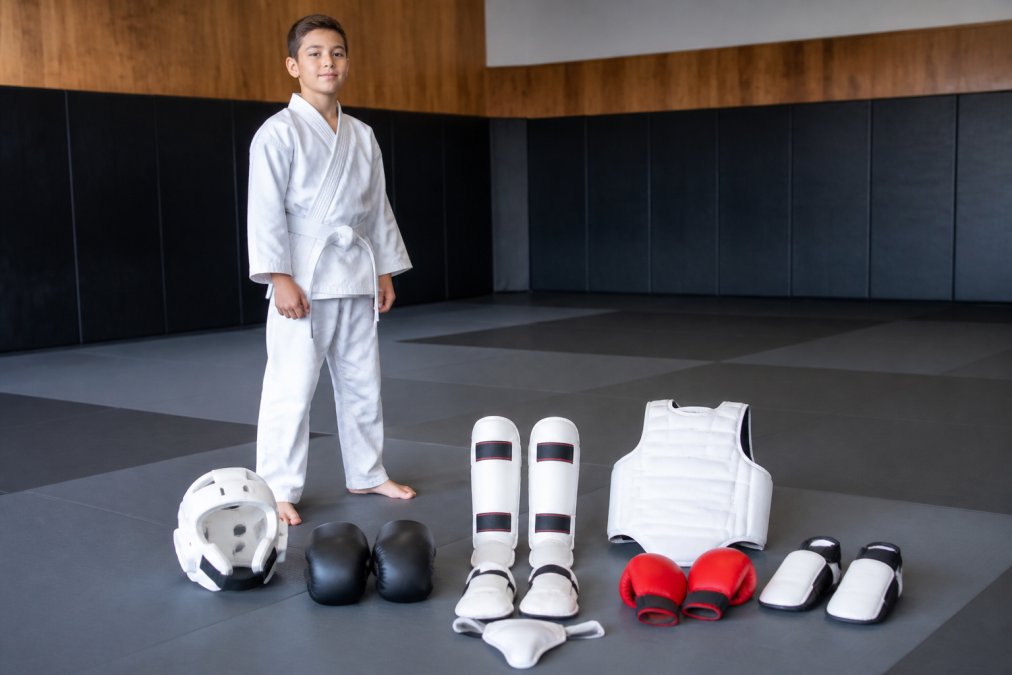
1. 6 oz. Lightweight Karate Student Uniform
This gi is made from a 60% cotton / 40% polyester blend, giving you breathable fabric with wrinkle resistance and durability. The full-cut jacket allows proper range of motion for kata and basic sparring, and the elastic waistband with internal drawstring keeps the pants secure through high kicks and deep stances. Reinforced stitching at the hems prevents fraying after months of training. The set includes jacket, pants, and a standard white belt. Machine washable, shrink-resistant, and wrinkle-resistant.
Best for: New karate students who need a complete, durable starter set.
2. 6 oz. Lightweight TKD Student Uniform
Taekwondo uniforms have specific requirements that differ from karate. This TKD dobok features a wider cut through the chest and shoulders to accommodate the high-volume kicking that defines the discipline. Built on a poly/cotton blend with traditional TKD cut, elastic waistband, and drawstring for adjustability, it handles the stress from repeated chamber kicks and spinning techniques. The set includes jacket, pants, and a white belt. Shrink-resistant fabric holds up to repeated laundering.
Best for: Taekwondo beginners and students whose dojo requires a traditional dobok cut.
3. 7 oz. Middleweight Student Uniform with Elastic Pant
The jump from 6 oz. to 7 oz. fabric is small in number but meaningful in practice. The heavier weave produces a satisfying snap during strikes and holds its shape better through rigorous training sessions. This uniform works across karate, taekwondo, and other traditional disciplines. The elastic waist pants with drawstring deliver a secure fit for all body types. Reinforced stitching in stress areas means this uniform outlasts lighter alternatives.
Best for: Students who train more than twice a week and want a uniform that holds up longer.
4. 8 oz. Middleweight Uniform with Elastic Pant
The 8 oz. middleweight uniform is the sweet spot for students who have moved past the absolute beginner stage. The cotton/polyester twill construction produces a crisp, professional look with six rows of reinforced stitching on hems and cuffs. Inside ties on the jacket keep the gi in place during high-intensity movement. Flat-locked seams reduce skin irritation during long training sessions. The gusseted crotch in the pants ensures full range of motion for deep stances and high kicks.
Best for: Intermediate students ready to upgrade from entry-level gear without moving to a full heavyweight uniform.
5. Double Wrap White Striped Karate Belt
A properly constructed rank belt. The double-wrap design wraps twice around the waist, providing the secure, traditional fit that single-wrap belts can't replicate. The 0.5" colored center stripe signals rank progression clearly, and the cotton/poly blend construction holds its shape wash after wash. Available in sizes from Child Small through Adult XXL and in stripe colors including yellow, gold, orange, green, blue, purple, brown, and red. This belt works across karate, taekwondo, judo, and Tang Soo Do.
Best for: Students at any rank level who need a durable, properly constructed belt.
6. Adjustable Velcro Striped Child's Karate Belt
Traditional belt knots are an obstacle for young children. This adjustable belt solves the problem with a hook-and-loop closure that children can fasten independently. The 0.5" rank stripe is present, the 1.75" width matches professional belt standards, and six rows of chain stitching prevent fraying. Available in Child Small and Child Large, with stripe colors covering the full junior curriculum: yellow, orange, green, blue, purple, red, and brown. Hand wash in cold water and hang to dry to preserve the Velcro closure.
Best for: Young students in early ranking stages who need a belt they can manage independently.
7. ProForce Lightning 5-Piece Sparring Gear Combo Set
A complete sparring kit covering essential protective equipment: headgear with shock-absorbing foam and ventilation, hand guards with secure fit, and foot guards built for fast footwork. The vinyl-dipped foam construction is durable and easy to clean. Hook-and-loop closures allow quick, adjustable fit across all pieces. The set includes a free mouthguard. Note: the headgear fits tight, so going up one size is recommended for a comfortable fit.
Best for: Karate and taekwondo students entering their first sparring sessions who need complete protective gear without buying individual pieces.
8. Century 5-Piece Karate & Taekwondo Sparring Gear Set
The 5/8" dipped foam provides excellent impact absorption with a contoured, ergonomic design. The headgear features pressure-release ear channels and an adjustable chin strap. The set includes student headgear, sparring gloves, sparring boots, a boil-and-bite mouthguard, and a drawstring mesh gear bag for ventilated storage. The smooth dipped foam surface is sweat-resistant and wipes clean between sessions. Tournament-ready for most sport karate and taekwondo competitions.
Best for: Students whose schools use Century gear standards, or competitors preparing for their first tournament.
9. Century 7-Piece Karate & Taekwondo Sparring Gear Set
The most complete sparring set available. The 7-piece configuration adds shin guards and a full-coverage mouthguard to the standard 5-piece kit, making it appropriate for full-contact sparring formats where lower-leg protection is required. The dipped foam construction uses premium material with ventilation holes positioned to maximize airflow during intense training. Ergonomic contoured gloves and boots provide a second-skin feel that supports precise footwork and clean technique. Available in red, blue, black, white, and neon pink, with sizing from Child through Adult XL. According to USA Martial Arts safety guidelines for youth sparring, proper protective padding coverage is essential for student safety during contact training; this set meets those standards.
Best for: Students who spar frequently or compete in formats requiring shin guard coverage.
10. ProForce Velocity Duffel Bag
Proper storage contributes significantly to gear longevity. The ProForce Velocity Duffel measures 27" x 12" x 11", large enough to carry a full uniform, headgear, gloves, shin guards, and accessories in a single trip. The Cordura nylon construction handles the weight of a complete sparring kit without seam stress. Five zippered compartments keep gear organized, while mesh ventilation panels reduce moisture buildup, the primary cause of odor in training equipment. The detachable, adjustable shoulder strap with swivel clips prevents twisting during transport.
Best for: Any student with a full sparring kit who needs organized, ventilated transport to and from the dojo.
Bundle vs. Individual: Which Buying Strategy Saves More
Buying individual pieces of sparring equipment almost always costs more than purchasing a combo set. Manufacturers build margin into individual items that bundles absorb. A 5-piece sparring set purchased as a bundle typically delivers better per-piece value than assembling the same five items separately.

The exception is when you already own one or two pieces in good condition. Buying a full 5-piece set when you only need boots and hand guards wastes money on duplicates.
The clearest buying framework:
- Starting from zero: Buy a combo set. The Century 5-piece or ProForce 5-piece are the logical starting points.
- Upgrading specific pieces: Buy individually. Replace worn items as needed rather than discarding a full set.
- Advancing disciplines: Reassess your full kit. Moving from point sparring to full-contact formats often requires adding shin guards and upgrading headgear impact absorption.
How to Choose the Right Size for Martial Arts Gear
Sizing martial arts gear correctly is where most first-time buyers go wrong. A headgear that shifts during impact doesn't protect. A gi that's too tight restricts technique.
For uniforms: Martial arts uniform sizing correlates to height and weight, not standard clothing sizes. When in doubt, size up. Traditional uniform cuts allow for better airflow with a slightly roomier fit.
For sparring gear: Measure head circumference for headgear, hand circumference for gloves, and foot length for boots. Gear that fits too loosely shifts during contact; gear that fits too tightly restricts circulation.
A practical sizing checklist:
- Measure head circumference at the widest point (above the ears)
- Measure hand circumference across the knuckles
- Measure foot length from heel to longest toe
- Cross-reference measurements against the specific product's size chart
- For children: account for growth, sizing up one level is reasonable for gear with adjustable closures
The ProForce Lightning headgear runs tight by the manufacturer's own note; go up one size from your measurement.
Second-Hand Gear and Smart Sourcing: What to Know Before You Buy
Second-hand martial arts equipment can save money, but not all gear is safe to buy used.
Safe to buy second-hand:
- Gear bags in good structural condition
- Uniforms with no significant fabric damage or fraying at stress points
- Belts (these are purely symbolic and carry no safety function)
Avoid buying second-hand:
- Headgear: foam degrades with impact over time, even when the exterior looks intact. A headgear that has absorbed significant contact may offer substantially reduced protection without any visible sign of wear.
- Mouthguards: these are single-user items. Never buy or share a used mouthguard.
- Shin guards and chest protectors: same foam degradation concern as headgear.
As noted by American Academy of Pediatrics sports safety guidance, protective equipment that has experienced significant impact stress may not provide adequate protection even when it appears visually undamaged.
Smart sourcing tips:
- Check dojo bulletin boards for graduating students selling gear they've outgrown
- Ask your instructor if the school has a gear swap program
- When buying new, prioritize sparring protective equipment over uniforms; the safety stakes are higher
How to Maintain Martial Arts Gear So It Lasts Longer
Knowing how to maintain martial arts gear properly is the single most underrated skill in a student's toolkit. Gear that's cleaned and stored correctly lasts two to three times longer than gear that isn't.
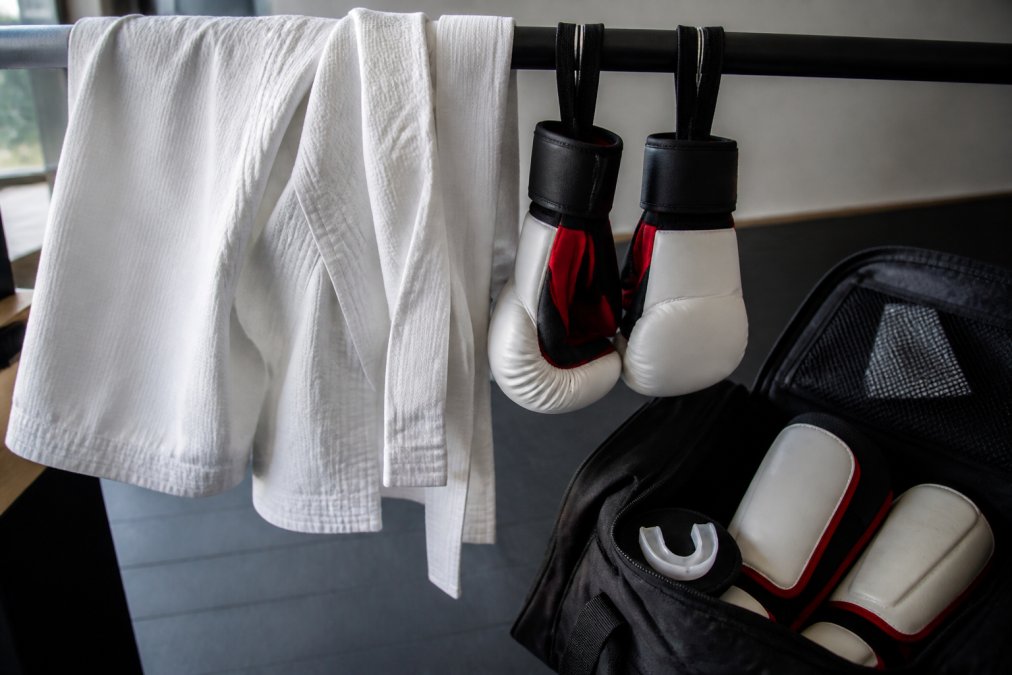
Uniform care:
- Machine wash in warm water, tumble dry on low. The 60/40 cotton-poly blend used in most student gis is engineered for this cycle.
- Never use hot water or high heat; this accelerates shrinkage in cotton-blend fabrics.
- Hang to finish drying if possible. Residual heat from a dryer can set wrinkles into heavier weaves.
- Wash after every training session. Sweat left in fabric breaks down fibers and creates persistent odor.
Sparring gear care:
- Wipe down dipped foam surfaces with a damp cloth after each session.
- Never store gear in a sealed bag immediately after training. Moisture trapped in foam creates mold and odor that no cleaning reverses.
- Use the mesh gear bag included with the Century 5-piece set, or the ventilated ProForce Velocity Duffel, to allow airflow during storage and transport.
- Air dry all sparring equipment completely before storing in any enclosed space.
Belt care:
- Hand wash adjustable Velcro belts in cold water and hang to dry. Machine washing degrades hook-and-loop fasteners over time.
- Double-wrap cotton/poly belts can be machine washed, but avoid high heat.
The Centers for Disease Control and Prevention guidance on hygiene in shared athletic facilities recommends that athletes clean personal protective equipment regularly to prevent skin infections common in contact sports environments.
Which Martial Arts Gear Option Is Right for You?
The right starting kit depends on three variables: your discipline, your training frequency, and your current stage.
| Student Profile | Recommended Starting Kit | Best Approach |
|---|---|---|
| Karate beginner, 1-2x/week | 6 oz. Karate Uniform + Striped Belt | Start light, upgrade later |
| TKD beginner, any frequency | 6 oz. TKD Uniform + Striped Belt | Discipline-specific cut matters |
| Child beginner, any discipline | 6 oz. Uniform + Velcro Child Belt | Independence in fastening |
| Student entering sparring | 7 oz. Uniform + 5-Piece Sparring Set | Bundle for value |
| Intermediate, frequent training | 8 oz. Uniform + 7-Piece Sparring Set + Duffel | Complete investment |
The 6 oz. lightweight uniforms are the right call for most beginners. The temptation to buy heavier gear immediately is understandable, but students grow, gain weight, and sometimes switch disciplines in their first year. Starting light keeps the initial investment low while you establish your training commitment.

The 7-piece sparring set over the 5-piece is worth the additional cost for students who know they'll be sparring regularly. Shin guards aren't optional in full-contact formats, and buying them separately later costs more than including them upfront.
The duffel bag is often treated as optional. It isn't. Gear stored in a random backpack or plastic bag deteriorates faster, smells worse, and gets damaged in transit. The ProForce Velocity Duffel pays for itself in extended gear lifespan alone.
BlackBeltShop carries all ten items listed here, priced 10-40% below regular retail, with free shipping on orders over $129. We also offer custom embroidered martial arts black belts tailored to your rank and style, choose custom kanji, names, or academy logos with high-density stitching built to last a lifetime of training. The veteran-owned business has earned 99.7% positive feedback across 14,728 reviews, with customers consistently highlighting fast shipping and items arriving exactly as pictured.
===
Frequently Asked Questions
Q: What essential gear do students need for martial arts training?
A: Most martial arts students need a uniform (gi), a rank belt, and basic protective gear. For karate and taekwondo, that means headgear, hand guards, foot guards, and a mouthguard. A sparring gear bag keeps everything organized. Beginners can start with a lightweight uniform and a 5-piece sparring combo set, then add pieces like shin guards as their training intensity increases. Your school or instructor will confirm which items are required before your first class.
Q: Is it better to buy martial arts gear in a bundle or individually?
A: Bundles almost always deliver better value for students. A 5-piece or 7-piece sparring combo set provides matched headgear, gloves, boots, and a mouthguard at a lower combined cost than buying each piece separately. Bundles also ensure consistent protective padding and sizing across all pieces, which matters for safety and comfort during sparring. Individual purchases make more sense when you need to replace a single worn item or upgrade one specific piece while keeping the rest of your kit.
Q: How do I choose the right size for a martial arts uniform?
A: Martial arts uniform sizing is based on height and weight, not clothing size. Most manufacturers provide a chart that matches your measurements to a numbered size. As a general rule, if you are between sizes, order one size up, traditional gis are cut to allow full range of motion, and a slightly roomier fit supports high kicks and deep stances without restricting movement. For children, factor in growth room. Always check the specific size guide for each uniform, since sizing can vary between lightweight and middleweight styles.
Q: How can students find durable martial arts gear without overspending?
A: Focus on fabric weight and stitching quality rather than brand logos. A 6 oz. to 8 oz. poly-cotton blend gi holds up well through frequent washing and daily training. For sparring equipment, dipped foam construction offers solid impact absorption at an entry-level price. Buying combo sets instead of individual pieces cuts costs significantly. Proper gear maintenance, airing out equipment after every session and washing uniforms correctly, extends the life of everything in your kit and reduces how often you need to replace items.
Q: What is the difference between entry-level and professional martial arts equipment?
A: Entry-level gear uses lighter fabric weights (6-8 oz. for gis) and standard dipped foam for protective padding. It suits beginners and intermediate students training a few times per week. Professional-grade equipment features heavier canvas weaves, higher-density foam, and reinforced stress points designed for daily high-intensity training and competition. For most students, entry-level gear provides the right balance of durability and cost. Upgrading to heavier or more specialized equipment makes sense once training frequency and competition demands increase.
Check out the full range of uniforms, sparring sets, and training accessories at BlackBeltShop. Building a complete student kit is straightforward when the gear is organized by discipline and experience level, and expert assistance is available to match equipment to your specific training goals and style.
This article was written using GrandRanker