

Table of Contents
- Essential MMA Training Gear for Beginners
- Quick Comparison: Affordable Protective Gear for MMA Athletes
- How to Choose MMA Shin Guards
- Best Affordable MMA Gloves, Headgear, and Ear Guards
- How to Size MMA Equipment for Beginners
- MMA Gear Maintenance Tips That Extend Lifespan
- Safety vs. Cost: What You Can and Cannot Skimp On
- Conclusion
- Frequently Asked Questions
Last Updated: September 11, 2026
Essential MMA Training Gear for Beginners
Stepping into MMA training without the right protective equipment is the fastest way to get hurt. A 2023 study in the Orthopaedic Journal of Sports Medicine found concussion rates in MMA are highest during sparring, not competition, so your daily gym bag matters more than your fight-night kit. This guide to affordable protective gear for MMA athletes covers what you need, what you can safely buy cheap, and where cutting corners will cost you.
Affordable protective gear for MMA means equipment that meets safety standards without premium pricing. The essentials are gloves, shin guards, headgear, a mouthguard, and a groin protector; everything else is optional until you know your discipline. Below, we break down each piece, how to size it, and how to make it last.
Quick Comparison: Affordable Protective Gear for MMA Athletes
Here's the gear that covers most beginners, with real prices from our catalog.
| Gear | Price | Best For | Key Feature |
|---|---|---|---|
| ProForce Open Palm Fighting Gloves | $42.99 | Striking and grappling | Open palm, hook-and-loop wrist strap |
| ProForce Combat Tactical Shin & Instep | $49.99 | Kickboxing, Muay Thai | Full shin and instep coverage |
| ProForce Ultra Strike Ear Guard | $24.99 | BJJ, wrestling | High-density foam, breathable |
| ProForce Thunder Full-Face Headgear | $44.99 | Sparring | Full-face coverage, vinyl exterior |
| Trainer's Tape, 15 Yards | $7.99 | Wrist and hand support | Strong adhesion, easy to tear |
That's the full starter kit for under $175, and it covers every major injury risk in beginner training.


How to Choose MMA Shin Guards
Shin guards are the piece beginners most often buy wrong, usually on looks rather than coverage. A good pair protects both the shin and the instep (the top of the foot), stays put during kicks, and doesn't restrict footwork. Cheap guards often skimp on instep coverage, exactly where beginners get hurt when checking kicks.
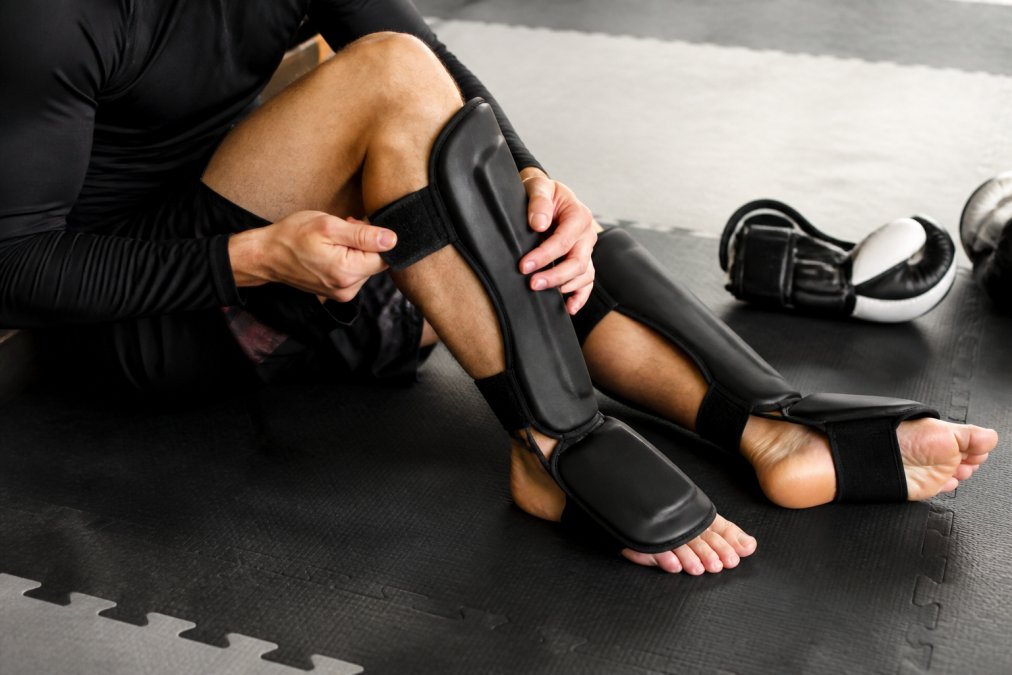
For most beginners, the ProForce Combat Tactical Shin & Instep Guards at $49.99 hit the sweet spot: full coverage, secure hook-and-loop closures, and lightweight enough for long sessions. If you're training Muay Thai seriously, the CREED Traditional Shin Instep Guards at $109.99 use full-grain leather and multi-layered foam for heavier impact, but that's a step up most beginners don't need yet.

Best Affordable MMA Gloves, Headgear, and Ear Guards
Gloves come in two types: open-palm grappling gloves and closed-fist boxing gloves. For MMA, you want open-palm. The ProForce Open Palm Fighting Gloves at $42.99 weigh about 4 ounces, use a hook-and-loop wrist wrap, and let you transition between striking and grappling without changing gear.
Headgear is where safety and cost genuinely trade off. The ProForce Thunder Full-Face Headgear at $44.99 is the budget pick: vinyl exterior, easy to wipe clean, full-face coverage. The Modus Pro Full Face Headgear at $64.99 upgrades to genuine leather and moisture-wicking lining, which matters if you're sparring several times a week.
For grappling, ear guards prevent cauliflower ear. The ProForce Ultra Strike Ear Guard at $24.99 uses high-density foam and adjustable straps. It's the single cheapest piece of gear that prevents a permanent injury.
How to Size MMA Equipment for Beginners
Sizing is where beginners lose the most money: wrong-sized gear gets returned, abandoned, or worn anyway and causes injury. Most people guess. Here is how to measure instead.
Gloves: measure your hand, not your height
MMA gloves are sized in ounces, and the rating is about padding thickness, not hand size. A 4-ounce open-palm glove is standard for MMA training and amateur competition. Heavier gloves (7 to 16 ounces) are for boxing and Muay Thai sparring, where more padding protects your partner as much as your hand.
To find your fit:
- Wrap a soft tape measure around your dominant hand at the widest point, just below the knuckles, hand flat.
- Roughly 7 to 8 inches fits a small, 8 to 9 a medium, 9 to 10 a large, and above 10 an extra large. Brands vary, so check the product page.
- With the glove on, make a fist: no gap between fingertips and the glove's end, no bunching in the palm.
A snug fit with no gap is correct. Loose gloves slip on impact and strain the wrist. Do not buy a size up to grow into.
Shin guards: measure the length of your shin, then check the instep
Shin guards are sized by height or shin length, depending on brand. Measure from the top of your foot, just below the toes, to just below the kneecap.
- Under about 13 inches: small or youth sizing.
- Roughly 13 to 15 inches: medium.
- Roughly 15 to 17 inches: large.
- Above 17 inches: extra large or tall sizing.
Then check the instep: hold the guard against your foot, and the padding should extend past the metatarsals. If it stops short, you will feel every checked kick. Straps should be snug enough that the guard does not rotate when you pivot.
Headgear: circumference plus a vision check
Measure your head circumference at the widest point, usually just above the ears and around the back of the skull. Most adult headgear fits roughly 21 to 24 inches, with adjustable rear and chin straps covering the range.
Fit test: snug enough not to shift when you shake your head, loose enough to see your partner's feet in your peripheral vision. If you must turn your head to see a kick, it is too tight or too low.
Ear guards: strap tension, not cup size
Ear guards are almost universally adjustable. Cups should sit flat over your ears with even pressure and no hot spots; if straps leave marks after ten minutes, loosen them. A guard that pinches gets taken off mid-round, defeating the purpose.
Mouthguards: fit is the whole product
A boil-and-bite guard that does not seat properly offers almost no protection. After molding, it should stay in place when you open wide, and you should breathe and speak without it shifting. If it pops loose when you talk, re-mold or replace it.
Groin protection: match the holder to the sport
Compression shorts with an integrated cup pocket hold the cup in place during grappling; loose jockstrap-style holders shift during takedowns. Size by waist measurement, not pants size, and check the cup sits centered and flat.
MMA Gear Maintenance Tips That Extend Lifespan
Gear that smells or falls apart early is usually a maintenance problem, not a quality problem.
Wipe down gloves, shin guards, and headgear with a damp cloth after every session, then air-dry them outside the bag. Never leave sweaty gear sealed in a gym bag overnight; that's what causes the smell and breaks down stitching. Wash rash guards and shorts after each use in cold water, and hang them to dry. For leather gear, a light conditioner every few months keeps it from cracking. According to the American Academy of Dermatology's guidance on skin infections in athletes, shared or poorly cleaned gear is a leading cause of skin infections like ringworm in contact sports, so cleaning is a safety issue, not just a comfort one.
USA Boxing's equipment standards also note that hand wraps and tape should be replaced regularly, since worn wraps lose their protective value. At $7.99 for 15 yards, Trainer's Tape is cheap insurance for your wrists and knuckles.
Safety vs. Cost: What You Can and Cannot Skimp On
The useful question is not "cheap or expensive" but "what does this gear actually do, and what happens when the cheap version fails?" Answer that for each item and the spending decisions make themselves.
The three failure modes of budget gear
Cheap protective equipment usually fails in one of three ways, and only one is acceptable:
- It wears out faster. The padding compresses, the stitching pulls, the closure stops gripping. Annoying, but safe. You replace it sooner.
- It fits poorly. Loose headgear rotates on impact. Oversized gloves slip and leave the knuckle exposed. This is a real injury risk, and it is the most common problem with budget gear.
- It never had the protection to begin with. Thin foam, no hard outer shell, a mouthguard that is a flat piece of rubber. No amount of careful use fixes this.
Category 1 is where you save money. Categories 2 and 3 are where you do not.
Safe to buy budget
These items protect against abrasion, sweat, and minor impact, and a budget version performs nearly identically to a premium one:
- Rash guards and shorts. The ProForce II Long Sleeve Rash Guard and ProForce Combat MMA Shorts do the same job as gear costing two or three times as much. Look for flatlock stitching and a four-way stretch fabric, and you are set.
- Hand wraps and trainer's tape. These are consumables. Buy them in quantity and replace them when they lose elasticity.
- Bag gloves and focus mitts for pad work, where you control the impact.
- Ear guards for grappling. The ProForce Ultra Strike Ear Guard uses high-density foam, which is the same material class used in premium ear guards. The difference is in the strap hardware and the lining, not the protection.
Do not skimp on these
Mouthguards. This is the one item where the cheap option is a different product, not a lesser version. A sporting-goods boil-and-bite guard is a flat sheet of ethylene-vinyl acetate you soften and bite into; it covers your teeth but does not stay seated when you take a punch to the jaw, and it does nothing for force transmitted up through the jaw joint toward the skull. A properly fitted guard, whether dentist-made or a well-molded dual-layer boil-and-bite, stays locked in place, cushions the jaw, and covers the back molars. If you are sparring, this is not the place to save.
Headgear. The mechanism matters more than the price. Full-face headgear with a hard outer shell and dense closed-cell foam disperses impact across a wider area; thin vinyl-covered foam compresses on the first hard shot and stays compressed. The ProForce Thunder Full-Face Headgear is a legitimate budget option with full-face coverage and a wipe-clean exterior. The next tier, like the Modus Pro Full Face Headgear, adds moisture-wicking lining and leather construction that survives several sessions a week without the foam breaking down.
Shin guards. The instep is the vulnerable part. Cheap guards pad the shin and leave the top of the foot thin. When you check a kick, that is the surface taking the impact. Full shin-and-instep coverage is non-negotiable.
Groin protection. A cup that shifts is worse than useless because you will trust it. Look for a compression short with an integrated pocket rather than a loose jockstrap-style holder.
The decision rule
Ask one question about each item: if this fails mid-session, what is the injury?
- Bruise, scrape, or a bad smell: buy budget.
- Sprain, broken bone, chipped tooth, or concussion: buy the version that fits correctly and has the right materials, even if it costs more.
That rule will save you money on half your bag and protect you on the half that matters.
Conclusion
Building an affordable MMA kit isn't about finding the cheapest option; it's about spending where protection matters and saving everywhere else. Start with gloves, shin guards, headgear, and a mouthguard, size them correctly, and maintain them after every session.
BlackBeltShop stocks sparring gear across karate, taekwondo, jiu-jitsu, and MMA, with free shipping on orders over $129 and expert help matching equipment to your discipline. As a veteran-owned business, we know what holds up under real training.
Get started with BlackBeltShop and gear up with protective equipment built to last through every round.
Frequently Asked Questions
Where can I find affordable MMA gear?
Look for online martial arts retailers that sell direct or offer bundles. BlackBeltShop, for example, prices items 10-40% below regular retail and gives free shipping on orders over $129. Starter sets like the Youth MMA Training Combo at $54.99 cover gloves, shin guards, and a rash guard in one purchase, which usually costs less than buying each piece separately.
How much does MMA gear cost?
A full beginner setup can run from about $150 to $300 depending on quality. At BlackBeltShop, individual pieces start low: Trainer's Tape at $7.99, a ProForce Ultra Strike Ear Guard at $24.99, and the ProForce Open Palm Fighting Gloves at $42.99. Bundled sets and free shipping on orders over $129 bring the total down further.
Is it safe to buy budget-friendly MMA sparring gear?
Yes, if the gear uses dense foam padding, secure hook-and-loop closures, and durable materials like synthetic leather or vinyl. Budget gear becomes unsafe when padding compresses after a few sessions or straps slip mid-round. Check that shin guards cover both shin and instep, and that headgear leaves your field of vision clear before you trust it in sparring.
How often should I replace my MMA protective equipment?
Replace gloves and shin guards every 6 to 12 months with regular training, or sooner if padding feels flat or stitching fails. Headgear and ear guards can last 1 to 2 years with proper care. Wipe gear down after every session, air-dry it fully, and check straps and closures monthly. Cracked vinyl or exposed foam means it is time to replace.
What are the essential pieces of protective gear for MMA training?
At minimum you need MMA gloves, shin guards, a mouthguard, and a groin protector. Add headgear and ear guards for sparring, hand wraps or trainer's tape for wrist support, and a rash guard to prevent mat burns. Beginners can start with a combo set and add pieces as sparring intensity increases.