

Table of Contents
- Why Professional Martial Arts Gear Matters for Every Practitioner
- How Protective Gear Reduces Injury Risk During Training
- The Confidence and Psychological Boost of Proper Protection
- How to Choose Martial Arts Sparring Gear for Your Discipline
- Best Protective Sparring Gear for Kids: What Parents Need to Know
- How to Clean Martial Arts Gear and Make It Last
- Cost, Durability, and Value: Why Professional Gear Saves Money
- Conclusion: Gear That Supports Your Martial Journey
- Frequently Asked Questions
Last Updated: October 9, 2026
Why Professional Martial Arts Gear Matters for Every Practitioner
Walk into any dojo and you will see the same split: some students train in loose gym clothes and borrowed gloves, others in gear built for the discipline. The difference shows up in how long they stay on the mat. Professional martial arts gear is equipment designed and tested for the specific demands of a combat discipline, rather than general athletic wear repurposed for training.
How Protective Gear Reduces Injury Risk During Training
Protective equipment reduces injury risk by absorbing and distributing impact before it reaches bone, joint, or soft tissue.
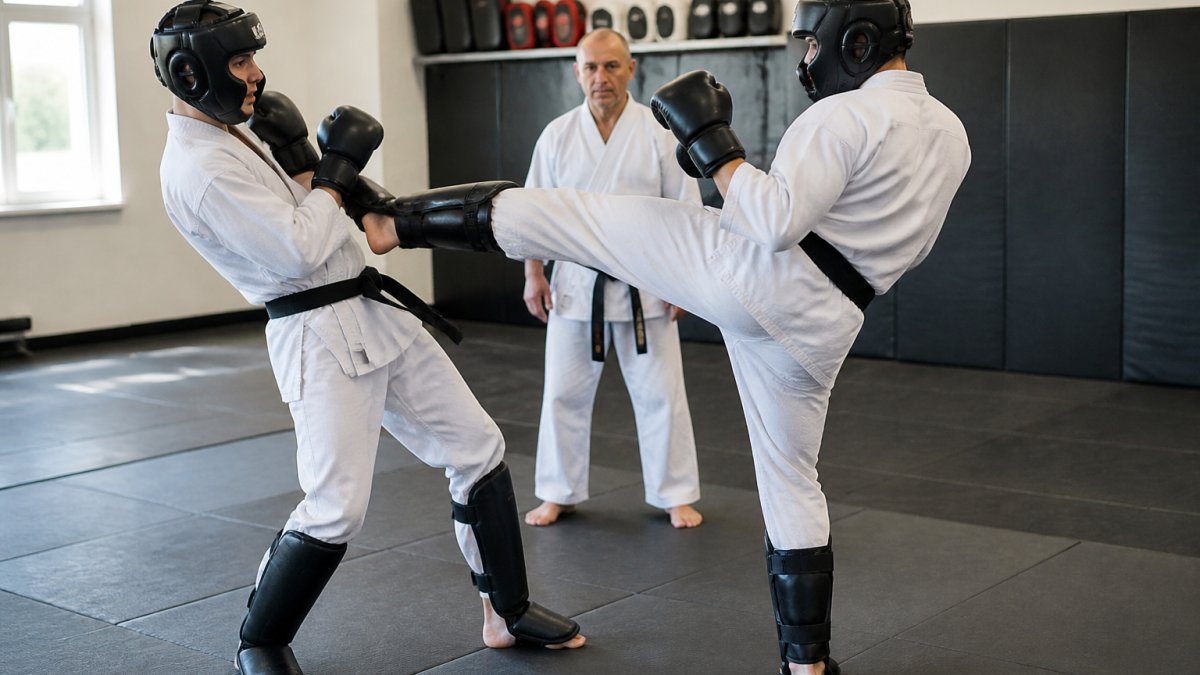
The equipment matters most in sparring, where contact is controlled but real. Train in the same gear you will compete in, so protection becomes automatic.
Coverage varies by discipline. Strikers need head, hand, and foot protection; grapplers need gear that will not snag or shift during a roll.
What the gear actually does, mechanically
Knowing how each piece works helps you spot when it has stopped doing its job:
- Foam guards (shin, instep, forearm): Dense closed-cell foam compresses on impact and spreads force over a wider area. When the foam hardens or cracks, it stops compressing and starts transferring force straight through.
- Headgear: Open-face and full-face designs use foam shells plus ear cutouts. They reduce cuts, abrasions, and some soft-tissue injury. They do not stop the brain from moving inside the skull.
- Mouthguards: A boil-and-bite guard creates a custom layer between upper and lower teeth, cushioning jaw impact and reducing laceration risk. A loose or chewed-through guard does neither.
Protection limits: what gear does not do
Protective equipment reduces the risk of many injuries but does not eliminate them or concussion risk. Headgear does not stop the brain from shifting inside the skull; mouthguards do not prevent concussion; shin guards do not prevent fractures from a hard enough impact.
Padded gear often changes where injuries happen rather than removing them, and athletes who feel protected sometimes take harder shots or return to sparring sooner than they should. If you take a hard shot to the head, stop, sit out, and get checked.
Standards and competition rules
Before you buy, check what your school or tournament actually approves. Rule sets differ, and gear that is fine in one venue may be disallowed in another. Karate competition under WKF rules specifies approved uniform and glove standards; World Taekwondo rules specify approved headgear, chest protector, and shin/instep guard colors and construction; boxing and MMA sanctioning bodies publish their own approved equipment lists.
A quick gear checklist by activity
Use this as a starting point, then confirm against your school's requirements:
| Activity | Core protection | Often overlooked |
|---|---|---|
| Karate (kumite) | Gloves, mouthguard, shin/instep guards, groin protector | Chest protector for youth and some divisions |
| Taekwondo sparring | Headgear, chest protector, shin/instep guards, gloves, mouthguard, groin protector | Forearm guards |
| Boxing | Gloves, hand wraps, mouthguard, headgear for amateur sparring | Groin protector |
| BJJ / grappling | Mouthguard, knee pads, ear protection if prone to cauliflower ear | Rash guard under the gi |
| MMA | Gloves, mouthguard, shin guards for sparring, cup | Headgear for controlled sparring rounds |
If you are not sure where to start, buy the pieces your discipline requires for live sparring first, then add the rest as intensity grows.
The Confidence and Psychological Boost of Proper Protection
Protection changes how you train, not just how safe you are. Students who trust their gear commit to techniques instead of pulling back at the last second, and that commitment is where real skill develops.
Suiting up also signals that training is serious. The routine of strapping on guards and tying a belt creates a mental switch that casual gym clothes never trigger.
How to Choose Martial Arts Sparring Gear for Your Discipline
Match the gear to the discipline first, then to your level of contact. A karate competitor needs different equipment than a jiu-jitsu grappler or an MMA striker, so start with the rules your school or tournament follows.
Here is how we would work through a gear selection:
- Identify your primary discipline and whether you train gi or no-gi
- Check your school's sparring requirements and any tournament rulebook
- Measure for fit using the manufacturer's sizing chart, not guesswork
- Buy the protection you will actually wear every session
- Add discipline-specific pieces as your training intensity grows
For karate practitioners, the PUNOK Training Uniform with Belt is WKF approved and comes as a complete set with a matching white belt, which covers both daily training and sanctioned competition. For kumite work, the PUNOK WKF Approved Karate Punches come as a red and blue set with hook-and-loop closure and a durable outer shell built for repeated impact.

Taekwondo students should look at leg protection. The ProForce II TKD Shin/Instep Guard uses a vinyl exterior over dense foam padding and adjusts with elastic straps and hook-and-loop closures. For students who train in shoes, the ProForce Gladiator Superlight Martial Arts Shoes use a non-marking rubber sole and a lace-free slip-on design.
Grapplers have their own needs. The MMA Shorts for BJJ and No-Gi are built with stretch fabric, reinforced double-stitched seams, and a minimalist design without pockets or zippers, which reduces snag risk on the mat.
| Gear | Discipline | Key Feature | Best For |
|---|---|---|---|
| PUNOK Training Uniform | Karate | WKF approved, belt included | Daily training and competition |
| PUNOK Karate Punches | Karate kumite | Red and blue set, hook-and-loop closure | Sanctioned sparring |
| ProForce II Shin/Instep Guard | Taekwondo | Vinyl shell, dense foam padding | Leg protection in sparring |
| ProForce Superlight Shoes | Taekwondo, karate | Non-marking sole, slip-on fit | Mat training and footwork |
| MMA Shorts | BJJ, no-gi, MMA | Stretch fabric, no pockets | Grappling and rolling |
Best Protective Sparring Gear for Kids: What Parents Need to Know
Kids need the same protection as adults, sized correctly and worn consistently. The best protective sparring gear for kids fits snugly, stays put during movement, and covers the areas their discipline actually targets.
Parents ask us constantly whether cheaper youth gear is good enough. Sometimes it is, for the first few months.
A few practical points for parents:
PUNOK TRAINING UNIFORM W/ BELT wkf approved →
- Measure head circumference, hand width, and foot length before ordering
- Prioritize headgear and a mouthguard for any striking discipline
- Check that straps and closures stay secure during a full class
The KIZE Sparring Combo Set bundles headgear, punches, and kicks in one kit for karate, taekwondo, and kickboxing. For families who only need head protection first, the KIZE Sparring Headgear comes in youth sizing from 20 to 21 inches and uses a reinforced hook-and-loop chin strap.


A mouthguard belongs in every kid's bag. The Shock Doctor Pro Mouthguard uses a boil-and-bite fit, a multi-layer shock-absorbing frame, and a built-in breathing channel.
How to Clean Martial Arts Gear and Make It Last
Clean gear lasts longer and smells better, and the routine takes minutes.
How to clean martial arts gear:
- Wipe foam guards, headgear, and gloves with a damp cloth after class
- Air gear outside the bag overnight so moisture can escape
- Wash uniforms and fabric guards according to the care label
- Spot clean vinyl exteriors rather than soaking them
- Check straps, stitching, and closures monthly for wear
The ProForce UCV II Mega Backpack separates gear into compartments, so sweaty guards are not pressed against a clean uniform. Ventilation between sessions does more for odor than any spray.
Uniform care deserves its own note. The ProForce Gladiator Double Wrap Karate Belt is designed to hold its color after repeated washes, which matters when rank color has to stay readable.
Cost, Durability, and Value: Why Professional Gear Saves Money
Cheap gear costs more over time. A bargain gi that tears in three months gets replaced two or three times a year, while a durable uniform lasts through years of regular training.
Durability comes from construction: reinforced stitching, sewn edges, and non-absorbent foam cores separate gear that lasts from gear that fails. Those details cost more upfront and less over a training career.
The lifecycle math
Here is how to run the numbers: take the purchase price and divide it by the number of training sessions the item realistically survives.
The same logic applies to consumables. A mouthguard that lasts a full season costs less per session than one chewed through in a month, and gloves with reinforced palm stitching outlast a cheaper pair that blows out at the seam.
Construction details that predict lifespan
When you compare two pieces side by side, look for these markers:
- Stitching: Double-stitched and bar-tacked seams at stress points (shoulders, crotch, palm) outlast single-stitched seams by a wide margin.
- Edges: Sewn edges on foam guards hold their shape longer than dipped or glued edges, which peel at the corners.
- Foam core: Closed-cell, non-absorbent foam resists sweat saturation; open-cell foam soaks up moisture, hardens, and stops absorbing impact.
When to replace gear
Gear does not fail all at once. Watch for these signals:
- Foam that has hardened, cracked, or lost its rebound
- Straps that no longer hold tension or closures that slip mid-session
- Stitching that has pulled at a stress point
Replace consumables on a schedule and inspect long-life gear monthly. A piece that has stopped absorbing impact is worse than no padding, because it transfers force instead of spreading it.
Where the value actually shows up
Professional gear pays off in three places: fewer mid-season replacements, fewer missed sessions waiting on a new piece, and better protection when you need it. The real return is how many sessions you get out of the gear before it stops doing its job.
Conclusion: Gear That Supports Your Martial Journey
Every practitioner faces the same challenge: staying healthy and consistent long enough to reach the next rank. The right equipment makes that possible, from your first uniform to your competition kit. BlackBeltShop carries WKF-approved uniforms, sewn-construction sparring sets, shin and instep guards, mouthguards, and gear bags for karate, taekwondo, jiu-jitsu, and MMA, with free shipping on orders over $129 and military discounts for prior service.
Frequently Asked Questions
Why should you wear protective gear during martial arts sparring?
Protective gear absorbs impact from strikes, kicks, and falls, reducing bruises, cuts, and more serious injuries. Headgear, gloves, shin guards, and mouthguards each protect specific areas during sparring. Beyond physical safety, the confidence of knowing you are protected lets you train with more commitment and discipline, which improves your overall training performance and helps you stay consistent in your martial journey.
What protective gear do you need for martial arts?
Requirements vary by discipline. Karate and taekwondo sparring typically calls for headgear, hand protection, foot protection, shin guards, and a mouthguard. BJJ and grappling rely more on a durable gi or no-gi shorts and a mouthguard. A basic starter kit includes headgear, sparring gloves, kicks or boots, shin guards, and a mouthguard. Check with your dojo or tournament organizer for approved equipment before competing.
Does martial arts gear help prevent injuries?
Yes. Proper protective equipment cushions impact to the head, hands, feet, and shins, lowering the risk of bruises, cuts, and fractures. Headgear and mouthguards also help reduce concussion risk, though no gear eliminates it entirely. Fit matters as much as the gear itself. Loose or worn equipment shifts during impact and offers less protection, so check straps and padding regularly and replace damaged pieces promptly.
How should martial arts protective gear fit?
Gear should feel snug but never restrict movement. Headgear must sit level with clear peripheral vision and a secure chin strap. Gloves should cover the knuckles with a firm wrist closure. Shin and instep guards should contour the leg without sliding. Always measure according to the manufacturer's sizing chart, such as head circumference for headgear, and size up for growing children rather than buying oversized adult gear.
How often should you replace martial arts sparring gear?
Inspect gear every few months. Replace headgear, gloves, or guards when foam compresses, seams split, or straps lose tension. Dipped foam can crack or peel over time, while sewn construction generally lasts longer. Mouthguards should be replaced each season or after any significant impact. Keeping a spare set of essential pieces means a worn item never interrupts your training continuity.