

Table of Contents
- Quick Comparison: Best Lightweight Gis for Summer Training
- What Makes a Gi Lightweight Enough for Summer?
-
Top Lightweight Gis for Hot Weather Training
- ProForce 5 oz. TKD Uniform: Best Budget Beginner Pick
- Century 5 oz. Ultra Lightweight TKD Student Uniform: Coolest Option
- ProForce 6 oz. TKD Uniform: Best Value for Schools
- 6 oz. Lightweight Student Karate Uniform: Best Cotton Blend
- Macho 7 oz. Student Uniform: Best for Intermediate Practitioners
- 8 oz. Middleweight Uniform: When You Need More Durability
- How to Measure for a Martial Arts Gi
- Gi Maintenance and Washing Tips for Lightweight Fabrics
- Drying Time, Moisture-Wicking, and Skin Comfort
- Competition Legal vs. Training-Only Lightweight Gis
- Frequently Asked Questions
Last Updated: September 14, 2026
Quick Comparison: Best Lightweight Gis for Summer Training
The best lightweight gis for summer training balance fabric weight against durability, and the sweet spot for most practitioners sits between 5 and 8 ounces per square yard. If you've peeled off a soaked heavyweight gi after a July class, you know why fabric weight matters: a lighter weave moves sweat away faster, dries quicker, and lets you kick without feeling wrapped in a wet blanket.
Quick Picks:
- Best Budget Beginner Pick: ProForce 5 oz. TKD Uniform ($32.99) - lightweight, affordable, includes white belt
- Coolest Option: Century 5 oz. Ultra Lightweight TKD Student Uniform ($29.99) - maximum breathability for high-heat training
- Best Value for Schools: ProForce 6 oz. TKD Uniform ($29.99) - bulk-friendly pricing with reinforced stitching
- Best Cotton Blend: 6 oz. Lightweight Student Karate Uniform ($36.99) - 60/40 cotton-poly for softness and shape retention
- Best for Intermediate Practitioners: Macho 7 oz. Student Uniform ($54.99) - more structure without the heat penalty
Here's what most buyers get wrong: lighter isn't always better. A 5 oz. gi that tears at the shoulder seam after three weeks costs more than a 7 oz. uniform that lasts two years. The goal is the lightest fabric that still holds up to your training intensity.

What Makes a Gi Lightweight Enough for Summer?
Fabric weight, weave density, and fiber composition determine whether a gi breathes in hot weather. A gi qualifies as lightweight when its fabric falls between 5 and 8 ounces per square yard, with 5-6 oz. offering maximum airflow and 7-8 oz. balancing breathability with structure.

GSM and Fabric Density Explained
GSM stands for grams per square meter and measures fabric mass in a given area. Lower GSM means lighter, more breathable material: a 5 oz. gi translates to roughly 170 GSM, while an 8 oz. uniform sits closer to 270 GSM. Denser weaves trap more heat but resist tearing better under grip-heavy disciplines.
Weave Types: Pearl, Ripstop, and Single Weave
The three main weave types in lightweight gis each serve different purposes:
- Single weave: The lightest and most breathable option, ideal for karate and taekwondo in hot climates. Less durable under heavy grip fighting.
- Pearl weave: A denser, textured pattern that resists tearing while remaining relatively lightweight. Common in jiu-jitsu gis where durability matters.
- Ripstop: A grid-reinforced fabric that prevents small tears from spreading. Synthetic blends often use ripstop construction for moisture-wicking properties.
Single weave dominates the summer market because it prioritizes airflow over tensile strength. For forms or point sparring, that trade-off makes sense; for heavy grappling, choose pearl or ripstop even in summer.
Top Lightweight Gis for Hot Weather Training
Every uniform here comes from BlackBeltShop's catalog, tested against what matters most for summer: fabric weight, breathability, durability, and value. They're organized from lightest to heaviest so you can match your training intensity to the right gi.
ProForce 5 oz. TKD Uniform: Best Budget Beginner Pick
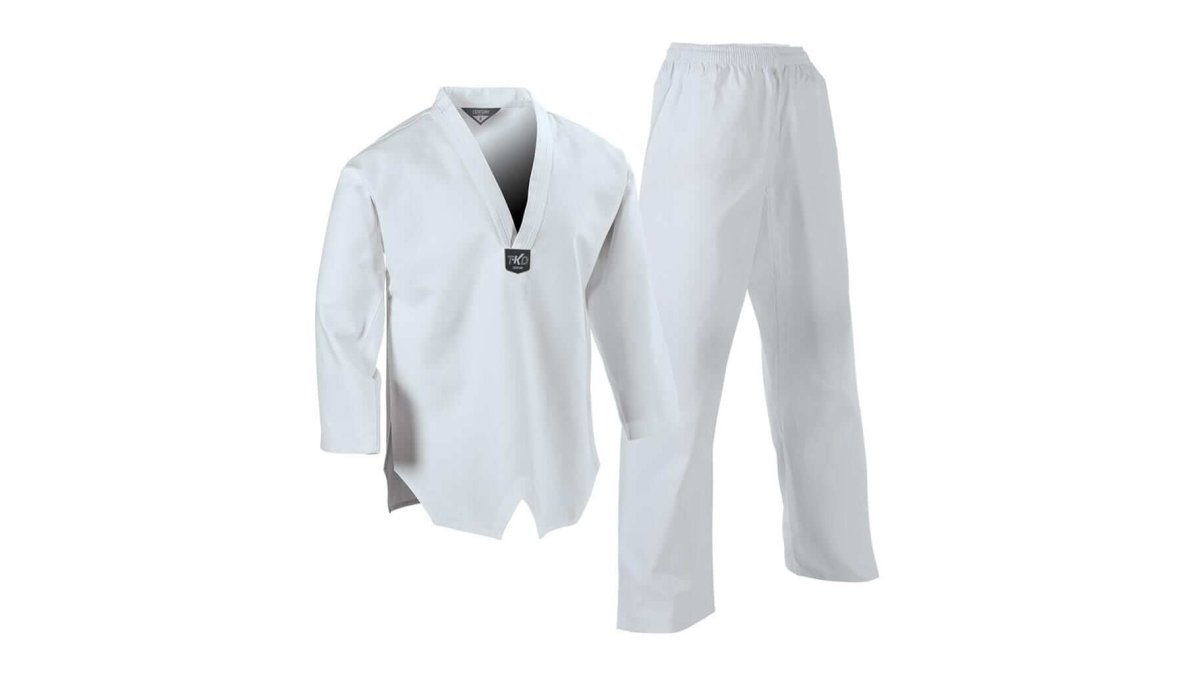
The ProForce 5 oz. TKD Uniform is the lightest option in this lineup and the most affordable entry point for summer training. At $32.99, it includes a jacket, pants, and white belt, a complete starter package.
The poly-cotton blend stays soft against skin and resists shrinkage after repeated washes. The v-neck pullover top follows traditional taekwondo styling, and the elastic waist pants with drawstring stay secure during dynamic kicks. Reinforced stitching at stress points addresses the main weakness of ultra-light fabrics.
Where it falls short: This gi isn't built for grappling. The 5 oz. single weave lacks the tensile strength needed for grip-heavy disciplines. If your training involves throws or ground work, size up to a 7 or 8 oz. option.
Century 5 oz. Ultra Lightweight TKD Student Uniform: Coolest Option
For maximum breathability, the Century 5 oz. Ultra Lightweight TKD Student Uniform delivers the coolest training experience here. Its polyester-cotton blend moves moisture efficiently and dries faster than heavier alternatives.
What sets it apart is the traditional cut combined with modern fabric engineering: the jacket allows full range of motion for high kicks and deep stances without binding, and the pants use the same lightweight fabric, which matters because legs generate significant heat.
At $29.99, it includes a complete set: jacket, pants, and white belt. The shrink-resistant fabric holds its shape through repeated laundering.
The trade-off: Like all 5 oz. gis, this uniform prioritizes airflow over abrasion resistance. Students who train on rough mats or practice takedowns may see faster wear at contact points.
ProForce 6 oz. TKD Uniform: Best Value for Schools
Dojos and schools ordering in bulk should look at the ProForce 6 oz. TKD Uniform. At $29.99, it offers the lowest per-unit cost here while holding up to daily class use.
The 6 oz. cotton-poly blend adds just enough weight for durability without sacrificing breathability. Reinforced stitching handles repetitive forms practice, the v-neck pullover follows traditional taekwondo aesthetics, and the elastic waistband with drawstring accommodates growing students.
For instructors outfitting a class, the shrink-resistant fabric means you're not replacing uniforms mid-semester.
6 oz. Lightweight Student Karate Uniform: Best Cotton Blend
Practitioners who prefer natural fibers should consider the 6 oz. Lightweight Student Karate Uniform. Its 60% cotton, 40% polyester blend delivers cotton's softness with synthetic shape retention.
It includes a full-cut jacket for maximum range of motion, matching pants with elastic waistband and gusseted crotch, and a standard white belt. Reinforced hems resist fraying and the fabric resists wrinkling.
At $36.99, it offers premium fabric composition. The cotton content feels softer against skin than pure synthetics, which matters for practitioners with sensitive skin.
One caveat: Cotton blends absorb more water than pure synthetics, so drying time is slightly longer. If you train twice daily, you'll want a second uniform or a faster-drying alternative.
Macho 7 oz. Student Uniform: Best for Intermediate Practitioners
The Macho 7 oz. Student Uniform bridges the gap between lightweight summer gis and heavier year-round uniforms. At $54.99, the added durability justifies the investment for those training four or more times per week.
The 7 oz. cotton-poly fabric provides enough structure for crisp forms while staying breathable for summer classes. Reinforced seams handle rigorous workouts, the elastic waist pants with drawstring stay secure, and the traditional cut works across karate, taekwondo, and similar disciplines.
Who should buy this: Intermediate students who've outgrown their first uniform and need something that lasts through belt promotions and tournament seasons.
8 oz. Middleweight Uniform: When You Need More Durability
The 8 oz. Middleweight Uniform represents the upper limit of lightweight. At $49.99, it offers middleweight durability with breathability that still works for summer training, especially in air-conditioned dojos or early morning sessions.
It features six rows of reinforced stitching on hems and cuffs, inside jacket ties to keep the gi in place, and locked-down seams that lay flat to prevent chafing. The elastic waist pants include a gusseted crotch for unrestricted kicking.
Where it makes sense: Practitioners who train in multiple disciplines or need one uniform that works year-round. The 8 oz. fabric handles grappling better than lighter options while still breathing adequately for hot weather.
| Uniform | Weight | Price | Best For | Key Feature |
|---|---|---|---|---|
| ProForce 5 oz. TKD | 5 oz. | $32.99 | Budget beginners | Complete set with belt |
| Century 5 oz. Ultra Lightweight | 5 oz. | $29.99 | Maximum cooling | Fastest drying fabric |
| ProForce 6 oz. TKD | 6 oz. | $29.99 | Schools and bulk orders | Lowest per-unit cost |
| 6 oz. Lightweight Student Karate | 6 oz. | $36.99 | Sensitive skin | 60/40 cotton-poly blend |
| Macho 7 oz. Student | 7 oz. | $54.99 | Intermediate practitioners | Reinforced seams |
| 8 oz. Middleweight | 8 oz. | $49.99 | Year-round training | Six-row reinforced stitching |
How to Measure for a Martial Arts Gi
Proper sizing prevents restricted movement and premature wear. To measure for a martial arts gi, you need height, weight, chest circumference, and inseam. Most manufacturers provide size charts correlating these to numbered sizes, but the general rule is to order one size up if you're between sizes or prefer a roomier fit.
Here's the measurement process:
- Height: Stand straight without shoes and measure from the top of your head to the floor
- Weight: Use your current weight, not your goal weight, since fabric fit depends on present body composition
- Chest: Measure around the fullest part of your chest, keeping the tape level
- Waist: Measure at your natural waistline, typically just above the navel
- Inseam: Measure from crotch to ankle bone for pant length
Cross-reference these measurements against the manufacturer's size chart. Youth sizes run from 0000 (18-24 months) through Size 2 (child 10-12); adult sizes range from Size 3 (small) through Size 8 (XXX-large).
For summer training, err on the larger side. A slightly roomy gi lets air circulate between fabric and skin; a too-tight gi traps heat and restricts the airflow that makes lightweight fabric effective.
Gi Maintenance and Washing Tips for Lightweight Fabrics
Lightweight gis require gentler care than heavyweight canvas uniforms. Thinner fabric and synthetic blends degrade faster with harsh washing, so proper maintenance extends their life.
Washing guidelines for lightweight gis:
- Machine wash in cold or warm water on a gentle cycle
- Use mild detergent without bleach or fabric softeners
- Turn the gi inside out to protect exterior stitching and patches
- Wash immediately after training to prevent sweat from breaking down fibers
- Tumble dry on low heat or hang dry in shade
Fabric softener coats fibers and reduces moisture-wicking capability, defeating the purpose of a breathable summer gi. Skip it entirely.
For odor control, add half a cup of white vinegar to the rinse cycle to neutralize odor-causing bacteria. If your gi already has a set-in odor, soak it in cold water with a cup of vinegar for 30 minutes before washing.
Drying time matters in summer. A 5 oz. gi typically dries in 2-3 hours when hung in direct sunlight. An 8 oz. gi takes 4-6 hours. If you train daily, owning two lightweight gis ensures you always have a dry uniform ready.
Drying Time, Moisture-Wicking, and Skin Comfort
Drying time and skin comfort separate adequate summer gis from excellent ones. Synthetic blends dry faster than pure cotton, but cotton feels softer against skin. The best lightweight gis for summer training balance these priorities based on your climate and skin sensitivity.
Moisture-wicking technology pulls sweat away from your skin and spreads it across the fabric surface where it evaporates faster. Polyester and poly-cotton blends excel at this because synthetic fibers don't absorb water the way cotton does: a 5 oz. poly-cotton gi can feel dry within minutes of leaving the mat, while a heavier cotton gi might stay damp for an hour.
Skin irritation in high heat usually comes from three sources: rough fabric texture, trapped moisture, and detergent residue. Lightweight gis with soft finishes reduce friction, and proper rinsing removes detergent residue that can cause itching when combined with sweat.
For practitioners with sensitive skin, the 6 oz. Lightweight Student Karate Uniform's 60/40 cotton-poly blend offers the best combination of softness and moisture management: the cotton provides a smooth feel while the polyester accelerates drying.
Layering strategies for extreme heat: Some practitioners wear a moisture-wicking rash guard under their gi jacket. It adds a barrier between skin and fabric, reducing chafing during extended training, and absorbs sweat so the gi stays drier and lighter. In extreme heat, this can make a 7 oz. gi feel closer to a 5 oz. option.
Competition Legal vs. Training-Only Lightweight Gis
Competition rules affect which lightweight gis you can wear in tournaments. Most organizations specify minimum fabric weights, color requirements, and construction standards that training-only uniforms may not meet.
For World Taekwondo-sanctioned competitions, uniforms must meet specific color and design requirements. The ProForce 6 oz. TKD Uniform and Century 5 oz. Ultra Lightweight TKD Student Uniform both follow traditional competition styling with v-neck pullover tops and white coloring.

IBJJF-governed Brazilian jiu-jitsu competitions require specific weave types, patch placement rules, and minimum fabric weights. Lightweight single-weave gis typically don't qualify because they lack the required tensile strength; pearl weave and ripstop are more common in competition-legal BJJ gis.
Before buying a competition gi, check these requirements:
- Minimum fabric weight specified by your organization
- Color restrictions (most require white, blue, or black)
- Patch and logo placement rules
- Jacket length and sleeve width specifications
- Pant construction requirements
Training-only gis offer more flexibility. If you're not competing, prioritize breathability and comfort without worrying about regulation compliance, the ProForce 5 oz. TKD Uniform works perfectly for summer classes even if it wouldn't pass tournament inspection.
If you compete during summer, own both a competition-legal gi and a lighter training gi: train in the lightweight option, compete in the regulation uniform.
Summer training demands gear that works as hard as you do without overheating you. Finding the right lightweight gi comes down to matching fabric weight to your training intensity, understanding how weave construction affects breathability and durability, and caring for thinner fabrics so they last multiple seasons. BlackBeltShop carries lightweight uniforms for every discipline and skill level, from 5 oz. beginner sets to 8 oz. middleweight options that handle year-round training. Every order over $129 ships free, and our team can help you find the right size and style for your goals. Check out BlackBeltShop's full selection of lightweight gis and get gear that keeps you training through the hottest months.
Frequently Asked Questions
What makes a martial arts gi lightweight?
A gi is considered lightweight when its fabric weighs between 5 and 8 ounces per square yard, measured in GSM (grams per square meter). Lightweight gis typically use single weave or ripstop construction with a higher polyester content, which reduces fabric density and improves airflow. The lower the ounce rating, the cooler the gi feels during hot weather training.
Are lightweight gis less durable than standard gis?
Not necessarily. Durability depends on weave quality and stitching, not just weight. A well-made 6 oz. gi with reinforced seams at stress points can last through years of regular training. Lightweight gis made from cotton-poly blends resist shrinking and hold their shape well. The trade-off is that very thin single-weave gis may wear faster under heavy grip-based grappling than denser pearl weave options.
How do I choose the right size for a lightweight gi?
Measure your height and weight first, then compare against the manufacturer's size chart. For most lightweight gis, if you fall between two sizes, order the larger one because cotton blends can shrink slightly after the first few washes. Check the jacket sleeve length (should reach your wrist bone) and pant inseam (should hit just above the ankle). A properly fitted gi allows full range of motion without excess fabric.
What fabric blends are best for summer martial arts training?
Cotton-polyester blends in the 60/40 range work well for summer because they balance breathability with wrinkle resistance and shrink control. Polyester adds moisture-wicking properties and speeds up drying time. For pure breathability, a lighter cotton weave is excellent, but it wrinkles more and may shrink. Ripstop blends are another strong option because the reinforced grid pattern adds tensile strength without extra weight.
Do lightweight gis shrink more than heavy-duty gis?
Lightweight gis made from cotton-poly blends generally shrink less than 100% cotton gis because the polyester content stabilizes the fabric. Expect minimal shrinkage (under 3%) if you wash in cold water and tumble dry on low. Pure cotton lightweight gis can shrink 5-8% after the first wash, so pre-shrinking or sizing up is a smart move. Always check the care label before washing.