

Table of Contents
- What Separates Durable Martial Arts Gear From Disposable Equipment
- Material Showdown: Leather, Synthetic Leather, Vinyl, and Cotton Blends
- Foam Padding Density and Impact Absorption Explained
- Best Protective Sparring Gear for Kids: What Parents Need to Know
- How to Clean Martial Arts Sparring Gear Without Breaking Down Materials
- Allergy, Skin Sensitivity, and Antimicrobial Considerations
- Conclusion
- Frequently Asked Questions
Last Updated: September 22, 2026
What Separates Durable Martial Arts Gear From Disposable Equipment
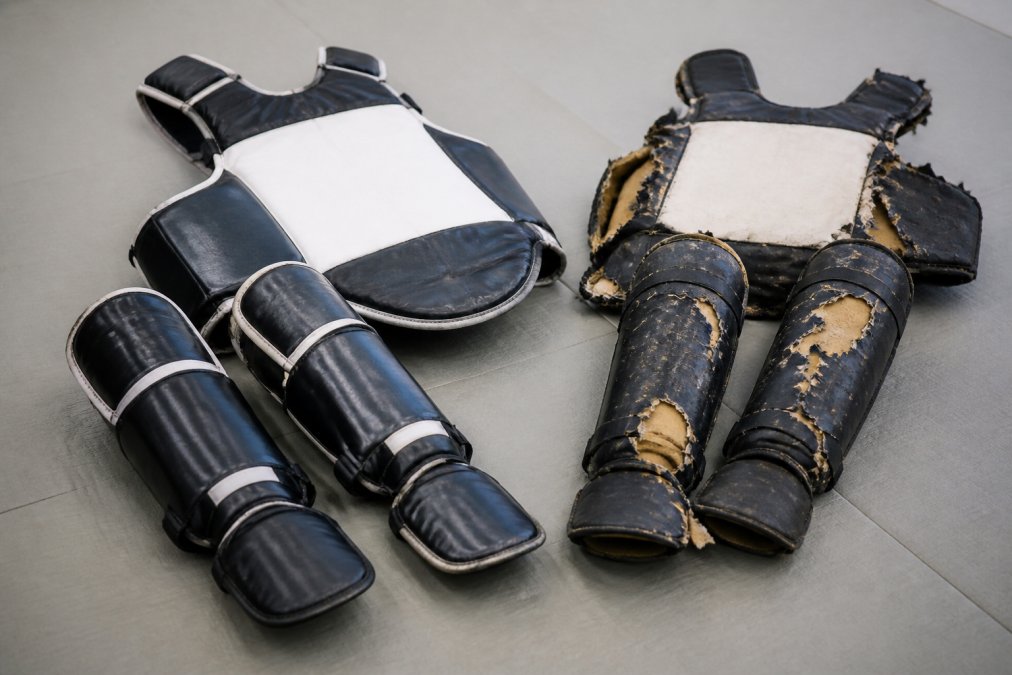
The best materials for durable martial arts protective gear come down to four things: dense, closed-cell foam that resists compression, a shell that holds up to abrasion, secure hook-and-loop closures, and a lining that manages sweat without rotting. Get those right and gear lasts years. Get them wrong and you're replacing torn shin guards every season.

This guide breaks down what each material actually does, where it wears out, and how to match it to your training intensity.
Material Showdown: Leather, Synthetic Leather, Vinyl, and Cotton Blends
Four material families dominate sparring equipment, and each fails in a different way. Knowing the failure mode matters more than knowing the marketing label, because the failure mode tells you how many seasons you actually get.
| Material | Abrasion Resistance | Breathability | Sweat Resistance | Typical Failure Mode | Best For |
|---|---|---|---|---|---|
| Full-grain leather | Highest | Moderate | High (with conditioning) | Surface cracking if never conditioned | Long-term daily training |
| Split-grain / bonded leather | Moderate | Moderate | Moderate | Delamination at glued layers | Mid-tier gloves, shin guards |
| Synthetic leather / PU | High | Moderate | High | Cracking at fold points in cold | Most sparring gear |
| Vinyl (PVC) | Low to moderate | Low | Moderate | Stiffening, seam splitting | Entry gear, easy cleanup |
| Cotton and cotton blends | Low | High | Low | Rotting, shrinkage, seam pull | Uniforms, liners, wraps |
Full-Grain Leather: Tensile Strength and Long-Term Value
Full-grain leather keeps its structure because the collagen fiber bundles run continuously through the entire hide rather than being split or reconstituted. That continuous grain is what gives it high tensile strength and real abrasion resistance, the surface doesn't delaminate because there's no glue line to fail.

Over months of training, full-grain molds to your body through a combination of moisture, heat, and flexing, so a glove or headgear shell gradually conforms to your anatomy.
Synthetic Leather and Polyurethane: Consistent Performance at Lower Cost
Synthetic leather is a polyurethane or polyester-spandex shell bonded to a knit backing. Its advantage is uniformity: every panel has the same thickness and density, so impact absorption is predictable across the whole guard rather than varying panel to panel the way natural hides can.
Vinyl: Where It Works and Where It Doesn't
Vinyl (PVC) is the budget option, and it earns its place in two scenarios: entry-level gear for a beginner who isn't sure they'll stick with the sport, and any piece that needs frequent, aggressive wiping. Vinyl doesn't absorb sweat, so it cleans easily.
Cotton Blends: Uniforms, Liners, and Wraps
Foam Padding Density and Impact Absorption Explained
Foam density decides how well a guard absorbs shock, and it's the spec most buyers never check. High-density closed-cell foam resists compression, so it keeps dissipating force after hundreds of strikes. Low-density open-cell foam feels soft on day one and flattens within months.
Here's what to look for:
- Closed-cell foam for repeated impact and sweat resistance
- Compression-molded padding for even shock dissipation
- Layered foam where a firm outer layer sits over a softer inner layer
- Ventilation channels to move heat away from the skin
- Reinforced strike zones where padding is thickest
Best Protective Sparring Gear for Kids: What Parents Need to Know
Best protective sparring gear for kids prioritizes fit, weight, and closed-cell padding over price. Children's gear that's simply a downsized adult version slips during movement, which is when injuries happen.
Look for these features:
ProForce Combat Tactical Shin and →
- Anatomical youth sizing, not adult gear marked "small"
- High-density foam at the shin, instep, and head
- Open-face headgear for peripheral vision
- Grab tabs or easy closures kids can fasten alone
- Breathable linings that resist odor between washes
How to Clean Martial Arts Sparring Gear Without Breaking Down Materials
Most cleaning guides tell you to wipe gear down and let it air-dry. That's correct but incomplete, because the cleaning agent you choose can destroy the material you're trying to protect. This is the part almost no guide covers: sanitization and material compatibility.
What Each Cleaning Agent Does to Each Material
| Cleaning Agent | Leather | Synthetic Leather / PU | Vinyl | Foam |
|---|---|---|---|---|
| Mild soap + water | Safe | Safe | Safe | Safe (surface wipe only) |
| Isopropyl alcohol | Dries and cracks grain | Can dull and degrade PU topcoat | Generally safe | Degrades some foams |
| Bleach | Destroys | Destroys | Degrades | Destroys |
| Ammonia-based cleaners | Destroys | Degrades | Degrades | Avoid |
| Disinfecting wipes (quat-based) | Avoid | Short-term OK | OK | Avoid |
| Vinegar solution | Avoid | OK (diluted) | OK | Avoid |
Alcohol is the trap. It's the go-to disinfectant for gyms, and on synthetic leather it strips the protective topcoat that keeps the PU from drying out, which accelerates the cracking you were trying to prevent. On leather it pulls out the natural oils and causes the grain to crack. On some closed-cell foams it breaks down the cell walls.
A Material-Safe Cleaning Routine
- Wipe the outer shell with a damp cloth and a few drops of mild dish soap
- Wipe the inner lining to remove sweat and salt, this is where odor and bacteria live
- For disinfection, use a diluted vinegar solution on PU and vinyl only, then wipe with clean water
- Air-dry in open air, never in a hot car or dryer
- Spot-clean straps and closures so hook-and-loop keeps its grip
- Store gear loosely, not compressed in a bag
Heat is the enemy across every material. High temperatures degrade polyurethane foam, warp vinyl shells, and dry out leather. A hot car in summer can hit temperatures that shorten gear life in a single afternoon.
Why This Matters Beyond Odor
Shared sparring equipment is a known vector for skin infections, and the Centers for Disease Control and Prevention guidance on cleaning sports equipment recommends regular cleaning of shared athletic gear to reduce that risk. But aggressive disinfection and material longevity pull in opposite directions. The goal is to disinfect without stripping the materials that make the gear durable.
Allergy, Skin Sensitivity, and Antimicrobial Considerations
Skin sensitivity and allergies are the overlooked factor in gear choice, and they decide comfort for a lot of athletes. Vinyl and some adhesives can trigger contact reactions in sensitive skin, while latex-based elastic straps cause problems for latex-allergic users.
Conclusion
Picking gear by material rather than price is what separates equipment that lasts from equipment you replace every few months. Match the shell, foam density, and closures to how hard you actually train, then maintain it properly.
Frequently Asked Questions
What are the most durable materials used in martial arts protective gear?
Full-grain leather and high-density polyurethane foam are the most durable options. Full-grain leather resists abrasion and holds up over years of training, while high-density foam maintains its shock absorption longer than low-density alternatives. Synthetic leather with polyurethane shells also performs well at a lower cost. Cotton blends work for uniforms but not for impact protection. The key is matching the material to the specific piece of gear and how often you train.
Is high-density foam or gel better for sparring protection?
High-density foam outperforms gel for most sparring applications. It distributes impact across a wider area and holds its shape through repeated strikes. Gel inserts feel comfortable initially but break down faster under heavy use, especially in shin guards and chest protectors. Many quality guards combine compression-molded foam with a durable outer shell for the best balance of shock dissipation and longevity. Look for gear that specifies foam density rather than vague padding claims.
How does moisture-wicking fabric improve martial arts gear longevity?
Moisture-wicking linings pull sweat away from the skin and let it evaporate, which prevents the material from staying damp during and after training. Damp gear breaks down faster because trapped moisture weakens adhesives, promotes bacterial growth, and degrades foam padding. Polyester-spandex blends and antimicrobial linings are common in quality sparring gear for this reason. Wiping gear down and letting it air-dry after every session extends its useful life significantly.
How do I maintain my protective gear to ensure it lasts longer?
Wipe down synthetic leather and vinyl surfaces with a damp cloth after every session, then air-dry away from direct heat. For fabric-lined gear, use a mild detergent solution and avoid soaking foam padding. Check hook-and-loop closures regularly and remove lint or hair that weakens the grip. Store gear in a ventilated bag rather than a sealed one. Rotating between two sets of shin guards or gloves during heavy training weeks gives each set time to dry fully and reduces wear.