

Table of Contents
- Quick Comparison: Durable MMA Shorts for Rigorous Training
- What Makes MMA Shorts Durable Enough for Intense Training
- The Difference Between Fight Shorts and Board Shorts
- Top Durable MMA Shorts for Grappling and Striking
- MMA Shorts Sizing Guide: Waistbands, Length, and Fit
- How to Wash MMA Fight Shorts Without Ruining Them
- Body Type Optimization and Stress-Test Methodology
- Conclusion: Gear That Keeps Up With Your Training
- Frequently Asked Questions
Last Updated: September 15, 2026
Quick Comparison: Durable MMA Shorts for Rigorous Training
Finding durable MMA shorts for rigorous training comes down to construction, not branding. Reinforced stitching, four-way stretch panels, and a secure waistband separate shorts that survive years of mat time from those that split during your first hard sparring session.
This guide from BlackBeltShop breaks down what holds up under grappling and striking, compares four proven options, and covers sizing, washing, and stress-testing.
| Short | Price | Key Construction | Best For |
|---|---|---|---|
| ProForce Combat MMA | $41.99 | Microfiber, split-thigh, hook-loop closure | Grappling and striking crossover |
| ProForce Thunder Board | $41.99 | 4-way stretch, moisture-wicking, side slits | No-gi and kickboxing |
| MMA Shorts BJJ No-Gi | $29.99 | Double-stitched seams, no pockets or zippers | Budget-conscious grapplers |
| ProForce Muay Thai | $36.99 | Satin, wide leg openings, drawstring waist | Muay Thai and kickboxing |
What Makes MMA Shorts Durable Enough for Intense Training
Durability in fight shorts comes down to three things: seam construction, how the fabric handles repeated stretch, and how the waistband holds under load.

Reinforced Stitching and Abrasion Resistance
Double-stitched and bar-tacked seams are the biggest predictor of gear longevity. Judging shorts by fabric feel alone is a mistake; seams fail first, usually at the crotch gusset and waistband attachment points.
Look for reinforced stitching at every stress point: inner thigh, rear rise, and where the waistband meets the body panel. Abrasion resistance matters most for grapplers, since mat friction wears fabric faster than striking drills.
Flex Panels, Four-Way Stretch, and Range of Motion
Four-way stretch panels let fabric expand in both directions, which matters for high kicks, sprawls, and takedown defense. Split-leg designs and side slits serve the same purpose by opening the leg during extended movement.
The Difference Between Fight Shorts and Board Shorts
Fight shorts and board shorts differ in construction, not just styling. Fight shorts are engineered for combat sports: reinforced seams, stretch panels, and waist closures built to stay locked during a scramble. Board shorts originated in surfing, where water resistance and quick drying matter more than abrasion resistance under body weight.

| Feature | Fight Shorts | Board Shorts |
|---|---|---|
| Primary seam | Flatlock or double-stitched with bar tacks at stress points | Single-stitched, often surged |
| Fabric stretch | Four-way mechanical stretch (typically 8-15% elongation) | Two-way or none |
| Waist closure | Internal drawstring plus hook-and-loop or rubberized grip band | Fixed elastic or simple tie |
| Crotch gusset | Reinforced panel, often bar-tacked | Rare or absent |
| Pockets | None or zippered only | Open slash pockets |
| Leg opening | Split-leg or side slits for kick range | Straight hem |
Why the waistband matters most. A fight short's waistband must resist a grip, hip toss, and sprawl without rotating or riding up. Serious fight shorts pair an internal drawstring with a hook-and-loop or silicone-grip band: the drawstring sets tension, the grip band stops fabric sliding when someone grabs your waist.
Why the gusset matters second. The crotch gusset is the highest-stress point on any grappling short. A board short has a simple seam where front and back panels meet; a fight short uses a diamond or triangular gusset panel that spreads load across three seams instead of one. Bar-tacked, it survives hundreds of hip escapes and bridges.
Where board shorts still work. For lifting, casual training, or open-mat warmups, board shorts are fine: lighter, cheaper, fast-drying. But for consistent no-gi grappling, Muay Thai clinch work, or MMA sparring, they will not survive.
If you train both striking and grappling, a hybrid fight short with split-leg construction and four-way stretch covers more ground than a pure board short or Muay Thai cut.
Top Durable MMA Shorts for Grappling and Striking
The four shorts below are ranked by how well their construction holds up under sustained training, using manufacturer specs rather than marketing claims.
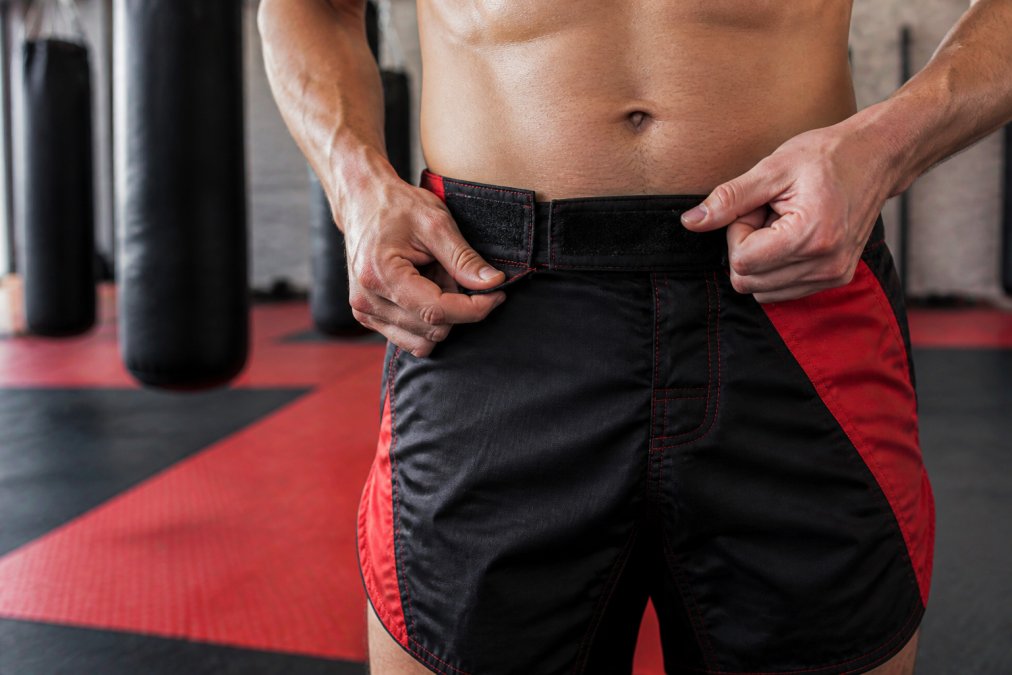
ProForce Combat MMA Shorts BJJ Jiu Jitsu MMA
The ProForce Combat MMA Shorts are the strongest all-round pick for athletes who train both grappling and striking. Lightweight microfiber resists abrasion through long sessions, and the all-way stretch supports full range of motion for kicks and transitions.
The elastic stretch waistband pairs with a reinforced hook-and-loop closure, keeping shorts secure without the slipping that plagues plain elastic waistbands. The split-thigh design stands out for high knees and complex ground transitions.
Pros: Split-thigh design for kicking, microfiber durability, secure hook-loop closure Cons: Limited to two color combinations, sizing tops out at 42 inches
ProForce Thunder Board Shorts BJJ Jiu Jitsu MMA
The Thunder Board Shorts lean harder into moisture management. Moisture-wicking material keeps you dry through long sessions, 4-way stretch panels deliver grappling flexibility, and reinforced stitching plus rip-resistant fabric address the two most common failure points.
Side slits increase range of motion for kickboxing and Muay Thai, and the hook-and-loop waist closure stays adjustable without sliding.

Pros: Moisture-wicking fabric, 4-way stretch panels, side slits for mobility Cons: Slightly less structured than the Combat model for pure striking
MMA SHORTS BJJ No Gi Brazilian Jiu Jitsu
At $29.99, these are the value pick, and the construction doesn't cut corners where it counts. Double-stitched seams hold up to high-intensity rolls, and the stretch fabric stays breathable while scrambling or bridging.
The minimalist design skips pockets and zippers entirely, reducing snag risk and removing the failure points cheap shorts always seem to have. The waistband combines elastic with a hook-and-loop closure for a secure, non-restrictive fit.
Pros: Lowest price point, double-stitched seams, no snag-risk hardware Cons: Fewer color options, plainer styling than the ProForce models
ProForce Muay Thai Shorts Kickboxing
Muay Thai shorts follow a different design language, and the ProForce model gets it right.
MMA Shorts Sizing Guide: Waistbands, Length, and Fit
| Measurement | How to Take It | Fit Impact |
|---|---|---|
| Natural waist | Measure at navel level | Determines base size |
| Hip circumference | Measure at widest point | Affects mobility and rise |
| Inseam preference | Thigh to desired hem | Determines striking vs grappling cut |
How to Wash MMA Fight Shorts Without Ruining Them
Body Type Optimization and Stress-Test Methodology
Matching the Cut to Your Body Type and Style
A Repeatable Stress Test You Can Run in Under Two Minutes
What Long-Term Wear Actually Looks Like
The Sustainability Angle Most Guides Ignore
Conclusion: Gear That Keeps Up With Your Training
Frequently Asked Questions
What features make MMA shorts durable for intense training?
Look for reinforced stitching at stress points, four-way stretch fabric, and abrasion-resistant material. A secure waistband with hook-and-loop closure plus an internal drawstring prevents slipping during takedowns. Split-leg or side-slit designs reduce tearing during high kicks and sprawls. Flatlock seams prevent chafing and blowouts. Durable MMA shorts from brands like ProForce use these construction details to survive repeated grappling and striking sessions without ripping or losing shape.
Should I choose board shorts or compression shorts for MMA?
Board shorts offer more freedom at the hips and are easier to grab during grappling, which is why most MMA and BJJ athletes wear them for no-gi training. Compression shorts sit tight against the skin and work better as a base layer underneath fight shorts. Many athletes wear compression shorts under loose fight shorts for added coverage and moisture-wicking. If you train both striking and grappling, a pair of durable MMA shorts with a split-leg design gives you the mobility of board shorts without the bulk.
How do I prevent my MMA shorts from ripping during sparring?
Choose shorts with reinforced stitching and rip-resistant fabric rather than thin cotton or low-quality polyester. Avoid shorts with pockets or zippers, which catch on fingers and tear. Wash them inside out in cold water and air dry to preserve seam integrity. Rotate two or three pairs so fabric has time to recover between sessions. If you notice loose threads at the waistband or crotch, repair them immediately before they become full tears.
Do I need different shorts for BJJ and MMA?
You can wear the same shorts for both if they have a split-leg or side-slit design, a secure waistband, and no pockets or zippers. BJJ no-gi athletes prefer shorter, tighter shorts that do not give opponents extra fabric to grip. MMA strikers often choose slightly longer board-style shorts for kicking coverage. A versatile pair like the ProForce Combat MMA Shorts works across BJJ, Jiu-Jitsu, and MMA because the all-way stretch design handles both ground work and high kicks.
How should MMA shorts fit for optimal mobility?
MMA shorts should sit snug at the waist without cutting in, and the hem should land just above the knee for striking or mid-thigh for grappling. You want enough room to throw a high kick and shoot a takedown without the fabric bunching or restricting your hips. Check the size chart carefully: waist sizes typically range from 26 to 42 inches. If you are between sizes, size up for grappling or stay true to size for a tighter competition fit.