

Table of Contents
- What You'll Need to Maintain Martial Arts Weapons
- Step 1: Clean Metal Blades and Weapons
- Step 2: Oil and Protect Wooden Weapons
- Step 3: Sand and Refinish Damaged Wood
- Step 4: Inspect Your Gear with a Martial Arts Weapon Inspection Checklist
- Step 5: Store Weapons to Prevent Warping and Damage
- How to Prevent Martial Arts Gear Odors
- Conclusion
- Frequently Asked Questions
Last Updated: September 12, 2026
What You'll Need to Maintain Martial Arts Weapons
Learning how to maintain martial arts weapons is the difference between gear that lasts a decade and gear that fails when it matters. Weapons that get cleaned, oiled, and inspected on a schedule outlast neglected ones by a wide margin.
Here's the short version before the details: metal needs cleaning and a protective film, untreated wood needs oil, finished wood needs inspection, and everything needs a dry, controlled storage spot.
Gather these supplies before you start:
- Soft cotton cloths or microfiber towels
- Light mineral oil for metal, boiled linseed oil for bare wood
- Fine-grit sandpaper (220 to 400 grit)
- A soft-bristle brush for crevices and wraps
- A storage case or stand for each weapon type
- A flashlight for inspecting cracks and pitting
A common mistake is grabbing whatever oil is in the garage. Motor oil carries additives that stain steel, and cooking oil turns gummy and rancid. Stick with products made for the job.
Step 1: Clean Metal Blades and Weapons
Metal care starts with removing moisture and residue before they do damage. Wipe the blade or metal head with a dry cloth after every session, then apply a thin film of oil. Skip this and rust pits the surface and weakens the steel over time.
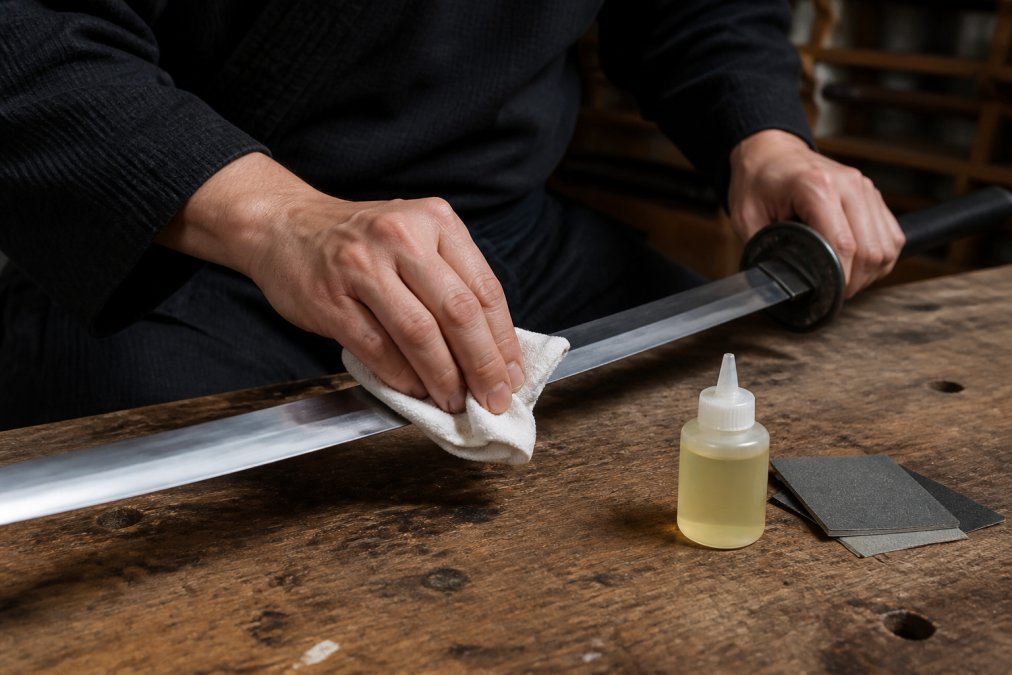
For a deeper clean, use a dedicated kit rather than improvised materials. The Sword Cleaning Kit Samurai or display includes the cloths and oil needed to protect a blade's finish without scratching it.

Removing Rust and Preventing Corrosion
Surface rust comes off with fine steel wool or 400-grit sandpaper and light oil, worked gently along the blade. Deep pitting is different: once rust eats into the metal, structural integrity is compromised and the weapon should be retired. Oil after every use and never store a blade in a leather sheath long-term, since leather holds moisture against steel.
Step 2: Oil and Protect Wooden Weapons
Bare wood dries out, and dry wood cracks. A bo staff, jo, or wooden training sword needs a light coat of oil every few months to keep the grain sealed and flexible. Wipe on a thin layer, let it sit fifteen minutes, then buff off the excess.

The part most guides skip is that "wood" is not one material. The oil that saves a red oak bo can ruin a finished bokken, and the wrong choice on a laminated weapon can lift the glue lines. Match the product to the wood and finish first.
Match the Oil to the Wood and Finish
Bare, unfinished hardwood (red oak, white oak, hickory, ash): These standard training species are porous enough to drink in oil. Boiled linseed oil is the traditional choice: it penetrates the grain, cures to a soft protective film, and does not leave the slick surface some furniture oils do. Reapply every two to three months in a dry climate, less often in humid air.
Bare exotic or dense hardwood (purpleheart, bloodwood, wenge, ipe): These species are far less porous and absorb very little oil; a heavy coat just sits on the surface and turns tacky. Apply a very thin film, buff aggressively, and accept that the wood will stay largely unfinished. Over-oiling dense exotics is a common way practitioners ruin an expensive weapon.
Lacquered, varnished, or urethane-finished weapons: Do not oil these at all. The finish is the seal; oil cannot penetrate it and only attracts dust and grime. Clean with a damp cloth, dry immediately, and inspect for chips. A chip is an entry point for moisture, so touch up small chips with a matching finish rather than oiling over them.
Laminated or glued weapons (many bokken and jo): Oil can soften some wood glues over time. Use the lightest possible film of a non-penetrating oil, or skip oil entirely and rely on paste wax. If a glue line starts to lift, stop oiling and retire the weapon from hard contact.
Boiled Linseed vs. Tung vs. Mineral Oil
- Boiled linseed oil: Penetrates well, cures in about 24 hours, amber tint, traditional. Rags soaked in it can self-heat and combust, so spread them flat to dry or soak them in water before disposal.
- Tung oil: Harder, more water-resistant cure than linseed, and it darkens the wood less. Pure tung oil cures slowly (days, not hours) and costs more; "tung oil finish" products are usually thinned blends, so read the label.
- Mineral oil: Does not cure, it stays liquid, making it a poor choice for a weapon gripped hard. It is fine for a quick wipe on handles and grips, and it is food-safe and non-combustible.
- What to avoid: Motor oil (additives stain and can be toxic on skin), cooking oil (turns gummy and rancid), and any oil with added scent or silicone, which leaves a residue that traps grit.
How to Apply Without Overdoing It
- Wipe the weapon with a dry cloth first. Sweat, skin oils, and chalk dust block penetration.
- Pour a small amount onto a cloth, not directly on the wood, a thin, even film, not a wet coat.
- Rub with the grain for a minute or two.
- Let it sit fifteen minutes, then buff off every trace of excess with a clean dry cloth.
- Let it cure 24 hours before use. A tacky weapon is not cured and will pick up dirt.
When Oiling Is the Wrong Answer
Oiling maintains healthy wood; it does not repair damaged wood. If a staff has a crack that catches a fingernail, a splinter running with the grain, or a soft spot from water damage, oil will not fix it and may hide it. Those weapons belong in the repair-or-retire decision, not the maintenance routine.
Step 3: Sand and Refinish Damaged Wood
Light surface damage is fixable at home. Deep gouges, splinters, and hairline cracks that run with the grain are not, because sanding them out removes too much material and weakens the weapon.
Step 4: Inspect Your Gear with a Martial Arts Weapon Inspection Checklist
A martial arts weapon inspection checklist turns a vague "does this look okay?" into a repeatable routine. Run it monthly, and always before a tournament or grading.
- Metal: check for rust, pitting, and loose fittings
- Wood: look for hairline cracks, splinters, and warping
- Handles and grips: confirm wraps are tight and not frayed
- Blades and edges: verify no nicks or rolled edges
- Connections: tighten screws, rivets, and tang fittings
- Storage: confirm cases are dry and weapons are not resting on bare concrete
Any weapon that fails a check gets repaired or replaced. A cracked bo staff can snap mid-strike, and a loose blade fitting is a safety hazard.
Step 5: Store Weapons to Prevent Warping and Damage
Storage is where most weapons quietly deteriorate. Wood warps when it sits on a damp floor or leans against a wall under its own weight, and metal rusts in humid air. Keep weapons off the ground, out of direct sunlight, and supported along their full length rather than at a single point.
Control Humidity, Not Just the Room
Relative humidity does the most damage and gets the least attention. Metal begins to corrode above roughly 60 percent humidity, and wood swells, shrinks, and warps as humidity swings. A stable environment matters more than a dry one, because repeated cycling stresses glue lines and grain.
Practical controls, from cheapest to most involved:
- Silica gel packets in a sealed case or bag. Recharge them in an oven when they stop absorbing, and set a reminder to swap them.
- A hygrometer to read the humidity in your training space or storage closet. You cannot manage what you do not measure.
- A dehumidifier for a basement or garage training space, the single biggest lever if your weapons live in a damp room.
- Vapor-corrosion-inhibitor (VCI) bags or liners for long-term metal storage. These release a protective vapor that coats steel surfaces and suit collectors storing blades they do not train with.
Practice Storage vs. Display Storage
These are different problems and they need different solutions.
Practice storage is about protection during transport and daily handling. A lined fabric case keeps a staff straight and shields it from knocks; a rigid case adds crush protection for travel and tournaments. The case must support the weapon along its length, one that lets a six-foot staff bow in the middle is doing the opposite of its job.
Display storage is about long-term stability and appearance. A wall rack or stand keeps weapons off damp surfaces, but a rack that holds a staff at two points and lets the middle sag will slowly bend it. For long weapons, look for multiple support points or a full-length channel, and keep display pieces out of direct sunlight, which fades finishes and heats the wood unevenly. For shorter weapons like kama or sai, a stand keeps them off damp surfaces; for long weapons, a dedicated case solves both support and transport at once.

The Repair-or-Replace Decision
Storage and inspection feed into the same question: is this weapon still safe? Maintenance keeps good weapons good. It cannot make a failed weapon safe. Use these criteria.
Retire the weapon if you find:
- A crack that catches a fingernail, or any crack running across the grain rather than with it
- A hairline crack that has grown since your last inspection, or that opens when you flex the weapon
- A glue line that has lifted on a laminated weapon
- Deep pitting on metal, where rust has eaten into the surface rather than sitting on top of it
- A loose tang, rattling fitting, or a blade that shifts in the handle
- A soft, spongy, or discolored spot in wood from water damage
Repair is reasonable when:
- The damage is surface-level, light scratches, minor dents, a dull edge
- A wrap or grip has loosened but the core is sound
- A fitting is loose but the metal and wood underneath are intact
When in doubt, retire it. A weapon is cheaper than an injury.
A Simple Storage Routine
- Wipe down every weapon after use, dry cloth for wood, oiled cloth for metal.
- Return it to its case or rack, never leaning against a wall or lying on concrete.
- Check the hygrometer monthly and recharge silica gel as needed.
- Inspect each weapon monthly and before any tournament or grading.
- Log anything that fails inspection and decide repair or retire before the next session.
How to Prevent Martial Arts Gear Odors
Gear odors come from bacteria and moisture trapped in fabric and padding, and the fix is airflow, not perfume. Let sparring gear and uniforms dry completely before they go back in a bag, and never leave damp gear crumpled in a locker overnight. Wash uniforms and wraps after every session with a mild detergent without fabric softener, which coats the fabric and traps odor. For gloves and shin guards, wipe the interior with a diluted vinegar solution and air dry in sunlight when possible. Rotate two sets of gear if you train daily so each set dries fully.
Conclusion
Weapons that get cleaned, oiled, and inspected on a schedule stay safe and last for years, while neglected gear fails at the worst possible moment. BlackBeltShop carries the cases, stands, and cleaning kits that make the routine easy, backed by free shipping on orders over $129 and gear built for rigorous training. Get started with BlackBeltShop and keep every blade, staff, and training tool ready for the next session.
Frequently Asked Questions
How do you clean wooden martial arts weapons?
Wipe wooden weapons like bo staffs and bokken with a dry cloth after each use to remove sweat and dirt. For deeper cleaning, use a slightly damp cloth, then dry immediately. Apply a thin coat of oil every few months to prevent drying and cracking. Avoid soaking the wood in water, which causes warping. Sand lightly with fine-grit sandpaper if the surface feels rough, then re-oil.
What is the best oil for bo staffs and bokken?
For wooden martial arts weapons, use natural oils like linseed oil or tung oil. These penetrate the wood, protect against moisture, and bring out the grain. Mineral oil works as a budget-friendly option for regular maintenance. Avoid motor oil or cooking oils that turn rancid. Apply a thin layer with a cloth, let it absorb for 15-20 minutes, then wipe off excess. Reapply every 2-3 months or when the wood looks dry.
How often should I inspect my martial arts weapons for cracks?
Inspect your weapons before and after every training session. Look for hairline cracks, splinters, or loose parts, especially on wooden staffs and handles. Check metal blades for rust, pitting, or dull edges. A thorough inspection monthly is also recommended. If you find a crack deeper than a surface scratch, stop using the weapon until repaired or replaced to prevent injury during training.
How should I store my martial arts weapons to prevent warping?
Store wooden weapons horizontally on a rack or in a climate-controlled area away from direct sunlight and heat sources. Avoid leaning them against walls for long periods, which causes warping. Use a weapon stand or padded case for protection. Keep metal weapons lightly oiled and in a dry place to prevent rust. Humidity below 50% is ideal. A vinyl or hard case works well for transport and long-term storage.