

Table of Contents
- What Martial Arts Use Training Weapons
- Complete Martial Arts Weapons List by Discipline
- Karate Weapons Training: Beyond Empty-Hand Fighting
- Bo Staff Martial Arts: Staff and Pole Weapons
- Nunchaku Training for Beginners: Getting Started Safely
- Weapon Forms, Sparring, and Partner Work
- Frequently Asked Questions
Last Updated: October 7, 2026
What Martial Arts Use Training Weapons
Many martial arts incorporate martial arts training weapons as core curriculum components, spanning ancient Eastern traditions to modern combat sports. Understanding which martial arts use training weapons helps practitioners choose a discipline aligned with their goals, whether mastering traditional forms, building self-defense skills, or competing at advanced levels.
Some martial arts treat weapons as foundational practice, others introduce them only at advanced ranks, and a few have evolved away from weapons entirely. Knowing this difference shapes your training path and equipment needs.
Traditional vs. Modern Weapon Training
Traditional weapon training emphasizes forms, kata, and the philosophical connection between practitioner and weapon. Modern training focuses on practical application, safety, and competition performance.
In traditional systems like Okinawan Kobudo and classical Chinese martial arts, weapons training begins early and follows a structured progression, with students learning history and cultural significance alongside technique.
Modern weapon training strips away ceremonial elements but adds structure for safety and measurable skill development. Many dojos offer weapons as separate tracks, letting students build foundational strength and control first, which reduces injury risk before introducing the complexity of handling a tool.
Complete Martial Arts Weapons List by Discipline
Kung Fu and Chinese Martial Arts
Kung Fu encompasses dozens of styles, most incorporating weapons training. The most common are the dao (broadsword), jian (straight sword), staff, spear, and flexible weapons like the rope dart and chain whip.
The dao broadsword, called the "General of All Weapons," is a single-edged blade optimized for cutting and chopping.
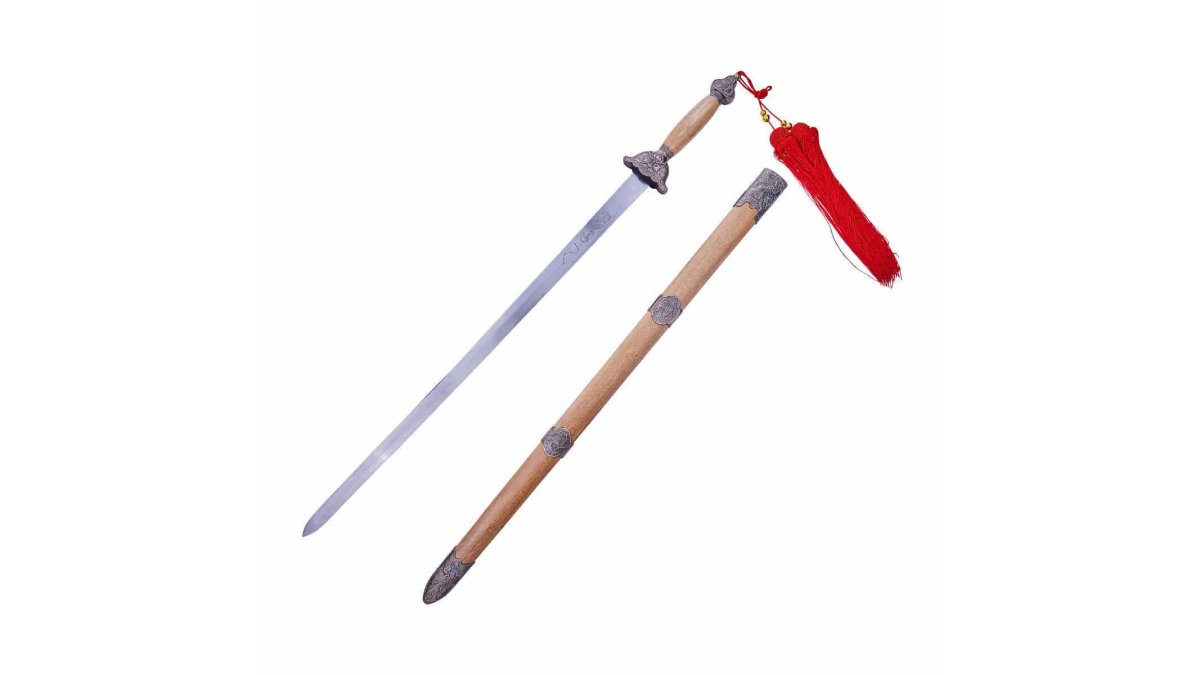
The jian, a straight, double-edged sword known as the "Gentleman of Weapons," demands precision, finesse, and control. Jian forms emphasize speed, agility, and quick direction changes, rewarding practitioners drawn to elegant, flowing movements.
For Kung Fu practitioners, BlackBeltShop carries the Dao Broadsword Kung Fu training sword at $124.99 and the Jian Kung fu training and Kata sword also at $124.99, both crafted for daily training with authentic weight and balance.
The bo staff (gun in Kung Fu) is a straight wooden pole, typically 6 feet long, used for striking, blocking, and sweeping. Staff training builds coordination, timing, and core power generation.
Japanese Martial Arts
Japanese martial arts divide into sword-based systems and weapons-heavy disciplines like Okinawan Kobudo.
Kendo focuses exclusively on sword fighting using the bokken (wooden practice sword) and katana (advanced training). Highly structured with formal rules and ranked tournaments, Kendo uses the bokken to teach proper sword mechanics safely.
Iaido emphasizes drawing, cutting, and resheathing the sword in one fluid motion, with practitioners spending years perfecting single techniques. The bokken is used initially, though many advance to real swords under careful supervision.
Kenjutsu, the umbrella term for traditional Japanese sword arts, includes schools favoring the katana, wakizashi (shorter sword), or tanto (knife). The bokken remains the safest training tool across all these systems.
BlackBeltShop offers the BOKKEN WITH SCABBARD with cord grip at $89.99, a hardwood practice sword ideal for Kendo, Kenjutsu, and Iaido training.
Filipino Martial Arts
Eskrima, Arnis, and Kali are closely related Filipino martial arts prioritizing stick and blade work from the start, with beginners using sticks immediately rather than a long empty-hand progression.
The primary weapons are escrima sticks (rattan or fighting sticks), lightweight and durable for partner drills and sparring. Most practitioners train with a pair, developing ambidextrous striking and blocking.
Filipino martial arts also emphasize knife training and empty-hand techniques mirroring stick mechanics. Once you master stick fighting, transitioning to empty hands or blades becomes natural since angles, footwork, and timing remain consistent.
The Red Escrima Sticks with Dragon Kali Pair from BlackBeltShop costs $44.99 and features lightweight rattan construction perfect for contact drills and rapid-fire combinations.

Okinawan Kobudo
Okinawan Kobudo emerged when Okinawa was occupied and civilians were forbidden from carrying swords. Practitioners adapted farm tools and everyday objects into weapons, creating a unique arsenal.
The primary Kobudo weapons are the bo staff, sai, tonfa, kama, and nunchaku. Each weapon has distinct characteristics and teaching progressions.
The sai, a three-pronged metal tool originally used for agriculture, excels at trapping, blocking, and striking. Its central prong extends forward while two curved prongs flare backward, creating multiple striking surfaces and a natural trapping mechanism.
The tonfa, a short stick with a perpendicular handle originally used to grind grain, becomes a defensive and striking tool in Kobudo, with training emphasizing spinning, blocking, and close-range power.
The kama, a sickle-shaped blade on a wooden handle, develops fine motor control and teaches safe, effective handling of a sharp blade.
BlackBeltShop carries Tonfas Karate Martial arts practice demo black or natural at $39.99, Black Plastic Sai Karate Kata Practice at $25.99, and Wood Bladed Kama demo karate martial arts at $27.99, all designed for safe, effective practice.
Karate Weapons Training: Beyond Empty-Hand Fighting
Most karate styles focus on empty-hand techniques, but many schools introduce weapons at intermediate or advanced ranks, varying by style and philosophy.
Okinawan karate styles like Uechi-ryu and Goju-ryu often incorporate Kobudo weapons, bo staff, sai, tonfa, and kama, reflecting the island's martial heritage.
Modern karate competitions rarely include weapons, but many traditional dojos maintain weapons training, with students often perfecting empty-hand kata for years before touching a bo staff or sai.
Shinai Bamboo Sword Karate Practice →
The shinai (bamboo sword) is sometimes used in karate for sword-based kata, particularly in schools with historical ties to Japanese sword arts, providing realistic feel without a metal blade's danger.

BlackBeltShop's Shinai Bamboo Sword Karate Practice at $61.99 offers premium bamboo construction with durable leather fittings, ideal for karate kata, kendo sparring, and traditional weapons training.
Bo Staff Martial Arts: Staff and Pole Weapons
The bo staff appears across multiple disciplines, making it one of the most versatile martial arts training weapons. It's central to Okinawan Kobudo, prominent in many Kung Fu styles, and used in some karate and taekwondo schools.
The bo staff teaches principles applicable to all weapons: hip power generation, footwork, timing, and distance management. A 6-foot staff is standard for adults, with shorter lengths for youth or those preferring speed over reach.
Bo staff training progresses from basic strikes and blocks to complex forms flowing for minutes. Advanced practitioners perform with remarkable speed and precision, making the bo staff as dynamic in competition as any empty-hand form.
The Burned Rattan Bo Staff from BlackBeltShop at $59.99 comes in multiple lengths (4 ft, 5 ft, 6 ft) with a distinctive spiral burn pattern.
Nunchaku Training for Beginners: Getting Started Safely
The nunchaku (also nunchuk or num chuk) is a flexible weapon of two wooden sticks connected by cord or chain. Originating in Okinawan Kobudo, it's iconic in popular culture, though many underestimate the skill required.
Nunchaku training develops hand-eye coordination, ambidextrous control, and management of a weapon moving independently of your hands. Unlike a bo staff, nunchaku swing around your body, creating multiple angles and striking surfaces.
Basic Exercises and Beginner Drills
Begin with the figure-eight pattern, the most fundamental nunchaku technique. Hold one stick in your dominant hand, let the other hang freely, and rotate your wrist in a figure-eight motion. This drill teaches basic stick control and builds muscle memory.
Progress to overhead strikes, swinging the nunchaku over your head and down toward an imaginary target. This requires coordination between both hands and teaches timing. Beginners often hit their own head or shoulders, normal, and it resolves with practice.
Side strikes follow the same principle horizontally. These drills form the foundation of nunchaku kata, which strings strikes into flowing sequences.
Most beginners need 4-6 weeks of consistent practice (3-4 sessions weekly) before executing basic forms without dropping the weapon or striking themselves, though this varies with prior experience and coordination.
Safe Training Equipment and Practice Tips
Start with lightweight foam, rubber, or plastic nunchaku to reduce injury risk during learning. As control improves, transition to wooden nunchaku for better feel and realistic weight.
The connection matters: beginners benefit from a longer cord or chain (8-12 inches), giving the weapon more time to complete its motion and reducing unexpected strikes. Advanced practitioners use shorter connections for faster techniques.
Train in an open space free of obstacles, walls, and low ceilings. A clear 8x8-foot area is ideal for safe nunchaku training.
The COMPETITION Nunchakus - FIRE AND ICE from BlackBeltShop at $84.99 features lightweight poplar wood construction and a holographic finish designed for demonstrations and competitions. Made in the USA, these nunchakus balance performance with durability for serious practitioners.

Weapon Forms, Sparring, and Partner Work
Weapon training progresses through three main activities: forms (kata), solo drills, and partner work.
Forms are choreographed sequences stringing techniques into flowing patterns. A bo staff form might last 2-3 minutes with dozens of strikes, blocks, and transitions.
Solo drills isolate specific techniques, repeated strikes, blocks, or footwork patterns, building speed, power, and consistency. A typical session includes 10-15 minutes of solo drills before forms.
Partner work introduces timing, distance management, and the ability to apply techniques against a moving opponent.
The transition from solo practice to partner work is significant. Solo forms feel smooth and controlled, but a partner moving unpredictably forces you to adapt.
| Training Type | Duration | Frequency | Best For |
|---|---|---|---|
| Solo forms practice | 20-30 minutes | 4-5 times per week | Building technique and muscle memory |
| Drills (strikes, blocks) | 10-15 minutes | Daily | Speed and power development |
| Partner drills | 15-20 minutes | 2-3 times per week | Applied timing and distance |
| Weapons sparring | 10-15 minutes | 1-2 times per week | Advanced practitioners only |
Martial arts that use training weapons span from ancient traditions to modern combat sports.
The key is matching the weapon and martial art to your goals. If you want to build practical self-defense skills quickly, Filipino martial arts' stick training delivers results fast.
At BlackBeltShop, we support practitioners at every stage. We offer free shipping on orders over $129 and expert assistance to help you find the right weapon and gear for your discipline and skill level. Check out our complete selection of training weapons and martial arts equipment.
Frequently Asked Questions
What martial arts use weapons in training?
Many martial arts incorporate training weapons, including Kung Fu, karate, taekwondo, aikido, and Filipino martial arts like Kali and Eskrima. Kung Fu practitioners train with swords (dao and jian), staffs, spears, and flexible weapons. Karate and Okinawan kobudo focus on traditional weapons like the bo staff, nunchaku, sai, tonfa, and kama. Japanese disciplines such as kendo, kenjutsu, and iaido emphasize sword training with the bokken or shinai. Each martial art has specific weapons integrated into its forms, sparring, and self-defense curricula.
Can beginners train with martial arts weapons safely?
Yes, beginners can train safely with the right equipment and instruction. Start with lightweight, durable practice weapons designed for safety, such as wooden or bamboo swords, foam-padded nunchaku, or plastic sai. Work with a qualified instructor who teaches proper grip, stance, and body motion before advancing to partner drills. Use protective gear when appropriate, and practice in a controlled dojo environment. Training weapons are specifically engineered to be safer than real weapons while still building authentic technique and power generation.
What is the difference between training weapons and real weapons?
Training weapons are designed for safety and skill development, not combat effectiveness. They use lighter materials (bamboo, rattan, wood, plastic), have dulled or unsharpened edges, and feature reinforced handles for durability during repeated practice. Real weapons are built for impact, cutting, or thrusting with full force. Training weapons allow practitioners to learn proper weapon handling, forms, and techniques without the danger of serious injury. This distinction is crucial for beginners and dojo practice, where the focus is on technique, body motion, and kata rather than live combat.
Which martial arts teach sword techniques?
Several martial arts emphasize sword training. Kung Fu teaches the dao (broadsword) and jian (straight sword), both central to traditional Chinese martial arts and Wushu. Japanese disciplines include kendo (bamboo sword sparring), kenjutsu (practical sword technique), and iaido (sword drawing and kata). Taekwondo sometimes incorporates sword forms, though it is primarily empty-hand focused. Korean martial arts and some Chinese styles also feature spear and sword techniques. Each tradition has distinct striking, thrusting, and cutting methods tied to its philosophy and combat applications.