

Table of Contents
- Getting Started: What You Need Before Your First Session
- Choosing the Right Nunchaku for Your Training
- Nunchaku Safety Tips Every Beginner Must Know
- Basic Nunchaku Spins and Strikes
- Building a Nunchaku Workout Routine
- Common Mistakes to Avoid
- Advancing Your Nunchaku Training
- Frequently Asked Questions
Last Updated: September 28, 2026
Getting Started: What You Need Before Your First Session
Nunchaku training for beginners at home requires three things: the right nunchaku, a small clear area, and consistent practice. You don't need expensive gear or a huge space.

The biggest mistake beginners make is buying the wrong equipment. Wrong gear hurts your wrists or breaks quickly, wasting time and money.
Nunchaku demand respect, focus, and patience, but anyone can learn the fundamentals at home.
Start by clearing a space about six feet in diameter. Remove breakable items and furniture.
Choosing the Right Nunchaku for Your Training
The right nunchaku choice shapes your entire learning experience. Wrong choice leads to poor control and frustration; right choice makes training natural and enjoyable.
Foam Nunchaku for Beginners
Foam nunchaku provide the safety you need while learning. Look for at least 1/4-inch foam padding with a solid inner core to protect your hands and face during drops and mishits.

Size and Handle Length
Kids need 8-inch handles; adults prefer 12-inch. If between sizes, choose smaller. Medium-weight foam nunchaku work best for beginners, light enough to control, heavy enough to feel during spins.
Nunchaku Safety Tips Every Beginner Must Know
Nunchaku safety means understanding how injuries happen and preventing them. Injuries follow predictable patterns; knowing them lets you avoid them.
Understanding Common Beginner Injuries
Impact injuries occur when you drop the nunchaku on your hands or wrists. Foam nunchaku reduce severity but don't eliminate impact. Your hands absorb force on every missed catch.
Progressive Protection Strategy
Phase 1: Maximum Protection (Weeks 1-4)
Wear padded gloves with reinforced hand and knuckle padding, plus wrist wraps underneath for compression and stability. Wrap snugly but not tight enough to cut circulation. Add forearm guards if you self-strike. Always practice in well-lit spaces so you can see your hands and the nunchaku clearly.
Phase 2: Moderate Protection (Weeks 5-12)
Phase 3: Minimal Protection (Week 12+)
Warning Signs to Stop Training
Sharp, localized pain means stop immediately and rest 24-48 hours. Dull, persistent aching signals repetitive strain; reduce volume by 50% for one week. Swelling that worsens requires ice and 48 hours rest. Numbness or tingling suggests nerve compression; loosen wraps and rest. If any pain persists beyond 48 hours, consult a healthcare provider.
Fatigue and Injury Prevention
Fatigue kills control and increases repetitive strain injury risk. Stop training when fatigue affects your form. A 20-minute focused session beats a 60-minute session with sloppy final minutes.
Practice Environment Safety
Clear a six-foot circular space with eight-foot ceilings. Remove breakables, sharp furniture, and trip hazards. Practice on flat, even surfaces. Never practice near others, keep your space isolated.
Basic Nunchaku Spins and Strikes
Master basic spins first. These foundational movements build the coordination and muscle memory needed for nunchaku training for beginners at home.
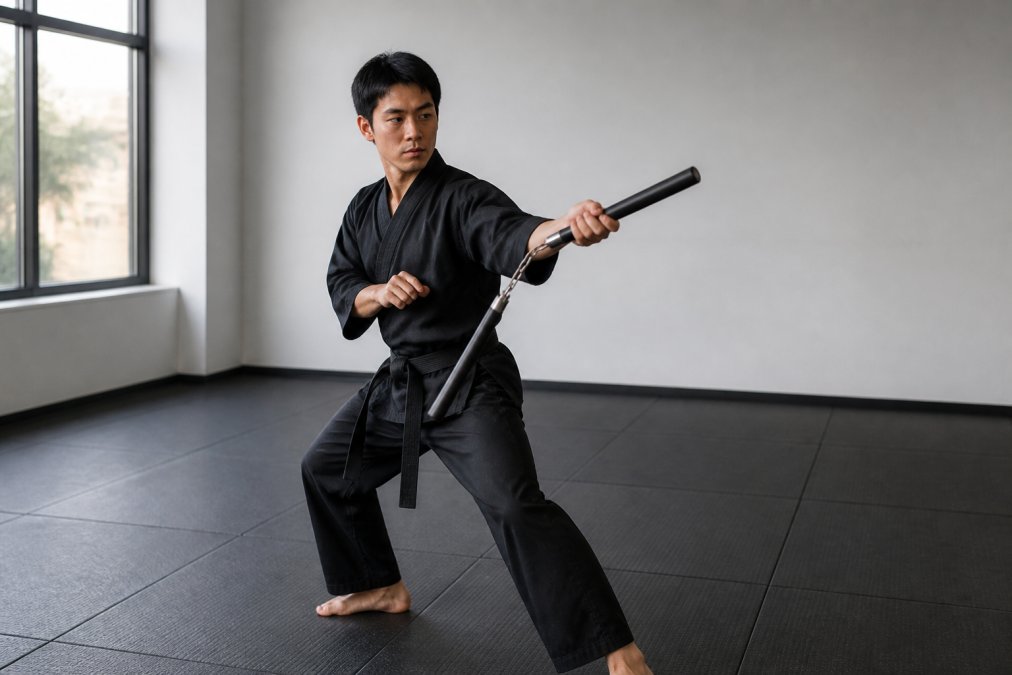
The Figure Eight Spin
The figure eight is the most important spin. Hold one stick in your dominant hand, let the other hang. Flick your wrist upward to rotate the nunchaku in a vertical circle, then catch the free stick with your other hand. Alternate which stick spins. Practice slowly, smooth, controlled spins matter more than speed.
The Wrist Flick and Basic Rotation
A proper wrist flick creates momentum with minimal arm effort. Flick upward in a small, snapping motion. Keep your grip firm but relaxed, tension kills smooth rotation. Practice vertical circles, catching with alternating hands to build hand-to-hand coordination for nunchaku training for beginners at home.
Forward and Backward Spins
Forward spins rotate away from your body; backward spins rotate toward it. Practice one minute of each, alternating to build balanced coordination in both directions.
Foam Cushion Grip Practice Nunchaks →
Building a Nunchaku Workout Routine
A structured routine drives steady improvement. Random practice leads to plateaus; logical progression shows noticeable gains every 2-3 weeks. Increase difficulty as skills improve to prevent boredom.
The Four-Week Beginner Progression Framework
This framework takes you from zero nunchaku experience to solid control of basic spins and simple combinations. Each week builds on the previous one.
Week 1: Foundation and Comfort (20 minutes, 3 sessions)
- Warm-up (5 min): Wrist circles, arm swings, forearm stretches
- Grip practice (5 min): Hold nunchaku in dominant hand, let other stick hang. Relax grip while maintaining control.
- Basic wrist flick (5 min): Flick upward in small vertical circle, slowly, using wrist not arm.
- Catch practice (3 min): Catch the free stick as it rotates. Missing is normal.
- Cool-down (2 min): Wrist stretches
Expectation: Complete 5-10 consecutive figure eights by week's end.

Week 2: Rhythm and Consistency (25 minutes, 3-4 sessions)
- Warm-up (5 min): Week one routine plus shoulder circles
- Figure eight spins (8 min): Slow, steady pace. Count aloud to develop rhythm.
- Wrist flick refinement (4 min): Small, snappy motion. Good flick does 80% of work.
- Forward spins (4 min): Nunchaku rotates away from body.
- Backward spins (2 min): Nunchaku rotates toward body.
- Cool-down (2 min): Wrist and forearm stretches
Week 3: Flow and Transitions (30 minutes, 4 sessions)
- Warm-up (5 min): Week two routine
- Figure eight spins (5 min): Maintenance practice
- Forward/backward combinations (8 min): Alternate 5 forward, 5 backward. Keep transitions smooth.
- Figure eight to forward spin transition (6 min): Link spins in different patterns.
- Free practice (4 min): Experiment linking spins in various orders.
- Cool-down (2 min): Full stretching
Week 4: Building Sequences (30 minutes, 4-5 sessions)
- Warm-up (5 min): Full warm-up
- Figure eight spins (3 min): Maintenance only
- Combination sequences (12 min): Build 30-60 second sequences. Example: 5 figure eights, 5 forward, 5 backward, 5 figure eights. Repeat smoothly.
- Basic strikes (6 min): Controlled overhead swings toward imaginary targets. Focus on control, not power.
- Flow practice (3 min): Link sequences with strikes.
- Cool-down (2 min): Full stretching
Expectation: Perform 60+ second sequences smoothly with controlled strikes.
Session Structure for Ongoing Training
Once you've completed the four-week framework, use this structure for all future sessions:
| Phase | Duration | Purpose |
|---|---|---|
| Warm-up | 5 minutes | Prepare joints and muscles, increase heart rate |
| Skill review | 5 minutes | Practice your most recent skill until it feels smooth |
| New skill introduction | 10 minutes | Learn or refine one new technique or combination |
| Integration practice | 8 minutes | Link new skills with previously learned techniques |
| Free practice | 5 minutes | Experiment and develop flow |
| Cool-down | 2 minutes | Stretch and recover |
Total: 35 minutes per session
Progressive Overload Principles
After week four, continue progressing by applying these principles:
Increase duration: Practice longer once techniques feel easy. Increase speed: Only after mastering at slow speed. Add complexity: Link more spins, introduce new techniques, combine spins with strikes. Reduce rest: Shorter breaks between drills build endurance. Track progress: Log what you practice to identify areas needing attention.
Avoiding Plateaus
Plateaus around week 6-8 are normal. When stuck, increase difficulty rather than volume. Add new techniques or try double nunchaku. Alternatively, focus on quality, practice figure eights obsessively, focusing on smoothness and rhythm.
Common Mistakes to Avoid
Beginners make predictable mistakes. Knowing what to avoid saves you time and frustration.
Advancing Your Nunchaku Training
Once you've mastered the basics, you're ready to progress. Advancement means learning new techniques and combining what you know into flowing sequences.
Frequently Asked Questions
Can you teach yourself nunchaku at home?
Yes, you can teach yourself nunchaku training at home with the right equipment and structured practice. Start with foam nunchaku for beginners, which are padded for safety. Follow step-by-step tutorials and practice basic rotations and spins in a clear space. Consistency matters more than intensity, even 15 minutes daily builds coordination and control. Many beginners progress successfully through self-directed home practice, though video instruction or training resources can accelerate your learning.
Which nunchaku is best for beginners to practice with?
Foam nunchaku for beginners are the best choice because they're padded for comfort and safety when you miss catches or hit yourself. Look for options with durable foam padding and a PVC inner core that provides structure without being hard. Chain-link or cord versions both work well, choose based on whether you prefer the smooth ball-bearing movement of chain or the traditional feel of nylon cord. Start with an 8-inch or 12-inch size depending on your height and arm length.
What safety precautions should I take when training with nunchucks at home?
Nunchaku safety tips include training in a clear, open space free of furniture, mirrors, and other people. Wear eye protection or train in a way that keeps your face clear of the weapon's path. Start slowly with basic rotations before attempting faster spins or strikes. Inspect your nunchaku regularly for damage, and always wear long sleeves to protect your forearms. Never train when tired or distracted, and keep a first aid kit nearby. Foam nunchaku reduce injury risk significantly compared to wooden or metal versions.
How long does it take to learn basic nunchaku techniques?
Most beginners can perform basic nunchaku spins and strikes within 2-4 weeks of consistent practice. Simple figure eights and wrist flicks typically take 1-2 weeks to master with daily 15-30 minute sessions. Developing smooth flow, speed, and control takes longer, usually 2-3 months of regular training. Progress depends on your hand-eye coordination, practice frequency, and whether you follow structured drills. Building a nunchaku workout routine with progressive skill drills accelerates improvement significantly.
Nunchaku training for beginners at home is achievable for anyone willing to practice consistently. Start with foam nunchaku from BlackBeltShop, follow a structured routine, and focus on technique over speed. The fundamentals you build in your first month shape your entire martial arts journey. Get started with quality foam nunchaku and the guidance you need to train safely and effectively.