

Table of Contents
- What Makes a Training Gi High Quality
- How to Measure for Martial Arts Gi
- Best Gi Material for Training
- Training Gi Options by Discipline
- Quick Comparison of Training Gis
- How to Care for Your Training Gi
- Common Mistakes When Buying Training Gis
- Conclusion
- Frequently Asked Questions
Last Updated: September 21, 2026
What Makes a Training Gi High Quality
Quality training gis start with fabric that survives repeated washing, intense movement, and years of wear. The difference between a uniform that lasts one season and one that lasts five comes down to three things: weave density, fiber blend, and seam construction.
Most gis use either 100% cotton or a cotton-polyester blend. Pure cotton feels softer initially but shrinks unpredictably and tears more easily at stress points like the shoulders and crotch. A 55% cotton / 45% polyester blend, like the fabric in BlackBeltShop's Hapkido Uniform, balances breathability with durability. The polyester resists shrinking and adds tensile strength without making the uniform feel synthetic.

Seam quality matters as much as fabric. Look for reinforced stitching at high-stress points: shoulder seams, side vents, and where the sleeve meets the body. A gi with single-layer stitching will split within months of regular training. Double or triple stitching, especially at the crotch and armholes where joint locks and throws create the most tension, is what separates a uniform that holds up from one that doesn't.
Weight matters too. Measured in ounces, a gi's weight indicates fabric density. A 5-ounce gi is lightweight and breathable, ideal for beginners or hot climates. An 8-ounce gi like the Hapkido Uniform offers more durability for advanced practitioners.
How to Measure for Martial Arts Gi
Getting the right fit prevents the uniform from riding up during kicks or restricting movement in the shoulders. A proper measurement takes three key dimensions.
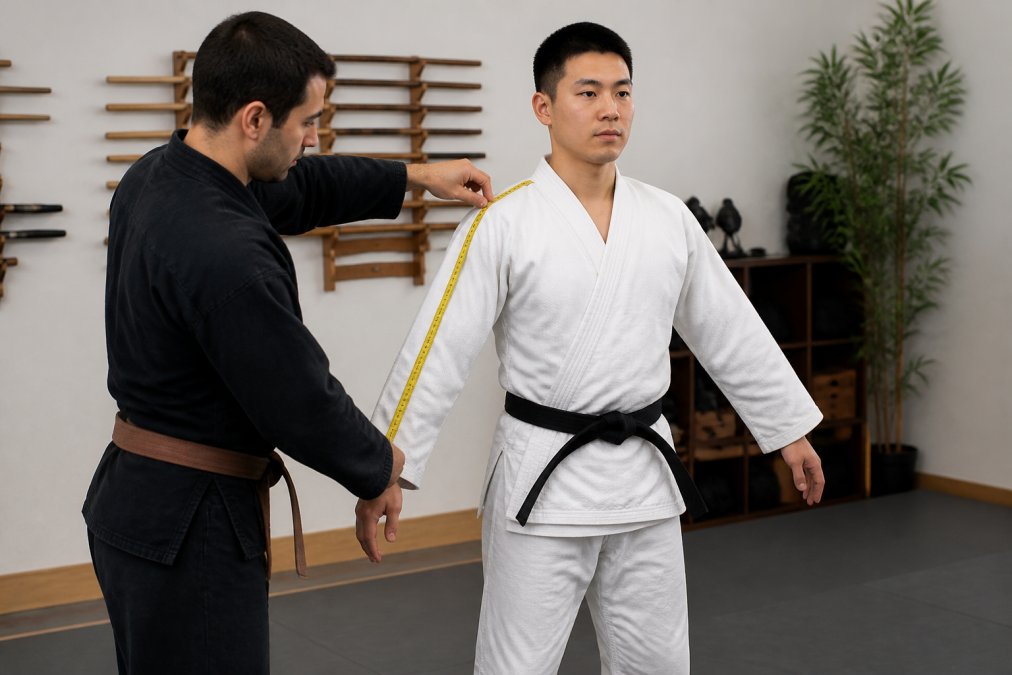
Shoulder width is measured from the tip of one shoulder to the tip of the other while standing relaxed. Tight shoulders restrict striking technique; loose shoulders bunch up during movement.
Sleeve length runs from the center back neck down to the wrist. The sleeve should end at your wrist bone, too short limits blocking range, too long gets caught during grappling.
Inseam is measured from the crotch to the ankle bone. In a fighting stance, pants should not ride above your ankle. If you're between sizes, measure yourself first.
Best Gi Material for Training
Cotton-polyester blends dominate the market because they balance performance with practicality. A 55/45 blend resists shrinking, dries faster than pure cotton, and holds up to repeated throws and joint locks.
For beginners, a lightweight 5-ounce blend works well. The ProForce 5 oz. TKD Uniform offers breathable fabric and solid construction for students learning their discipline.
For advanced practitioners and competitors, an 8-ounce gi provides durability for high-frequency training. The Hapkido Uniform Black with White Stitching uses an 8-ounce blend with reinforced stitching at stress points to resist tearing during joint locks and throws.
Avoid 100% cotton unless you accept significant shrinkage and longer drying times between training sessions.
Training Gi Options by Discipline
Different martial arts place different demands on a uniform. Karate requires full shoulder mobility for striking. Taekwondo requires hip flexibility for high kicks. Hapkido requires seam strength at stress points for throws and joint locks.
Karate Gis
Karate gis are typically white and designed for both training and tournament competition. The World Karate Federation (WKF) has specific regulations for tournament uniforms.
The PUNOK TRAINING UNIFORM W/ BELT WKF APPROVED meets competition requirements and includes a white belt. The uniform is lightweight enough for mobility but durable enough for daily training and sanctioned tournaments.

For karate, fit is especially important because the jacket needs to allow full range of motion in the shoulders. Tight gis restrict technique; loose gis create safety hazards during partner drills.
Taekwondo Uniforms
Taekwondo uniforms, called doboks, emphasize hip flexibility and leg mobility for kicks. Most use a v-neck design in white with colored trim or, for poomsae competition, white jacket with blue pants.
The ProForce 5 oz. TKD Uniform is an affordable entry point for beginners. It's lightweight, includes a white belt, and comes in multiple sizes for children and adults.
For serious competitors, the Adidas Taekwondo WT Poomsae uniforms are engineered specifically for forms competition. The 55% cotton / 45% polyester blend holds its shape during deep stances and produces a crisp "snap" sound when you strike. Both Youth and Adult versions are World Taekwondo (WT) approved for sanctioned competition.
For sparring, protective gear matters as much as the uniform itself. The ProForce II TKD Shin/Instep Guard and White ProForce II TKD Glove are designed for taekwondo-specific techniques and approved for many dojangs and tournaments. The shin guards have dense foam padding and contoured design; the gloves include finger and thumb loops with ventilation holes.
Hapkido Gis
Hapkido uniforms are traditionally black with white stitching, distinguishing them visually from karate and taekwondo uniforms.
The Hapkido Uniform Black with White Stitching 8 oz gi is purpose-built for Hapkido training. The 8-ounce fabric balances durability and mobility, with reinforced stitching at shoulders, side vents, and crotch area to withstand joint locks and throws.
The uniform does not include a belt. The 55% cotton / 45% polyester blend resists excessive shrinking and wrinkling, which matters because Hapkido training involves being thrown to the ground repeatedly.
Quick Comparison of Training Gis
| Uniform | Price | Weight | Best For | Key Feature |
|---|---|---|---|---|
| PUNOK Training Uniform (Karate) | $39.99 | Lightweight | WKF tournament competition | Includes white belt |
| ProForce 5 oz. TKD Uniform | $32.99 | 5 oz. | Taekwondo beginners | Most affordable entry point |
| ProForce 5 oz. TKD Uniform with Flag | $34.99 | 5 oz. | TKD training with style | Patriotic v-neck design |
| Adidas WT Poomsae (Youth Male) | $159.95 | Premium blend | Forms competition | WT approved, tailored fit |
| Adidas WT Poomsae (Youth Female) | $169.95 | Premium blend | Forms competition | WT approved, tailored fit |
| Adidas WT Poomsae (Adult Female) | $169.95 | Premium blend | Advanced forms competition | Professional silhouette |
| Hapkido Uniform 8 oz. | $91.99 | 8 oz. | Joint locks and throws | Reinforced stress-point stitching |
How to Care for Your Training Gi
A gi that's cared for properly lasts significantly longer than one that's neglected. The key is understanding how washing, drying, and storage affect the fabric and seams.

Wash your gi in cold water with mild detergent. Hot water accelerates shrinkage, especially in cotton-heavy blends. Use a gentle cycle rather than heavy agitation, which stresses seams over time. If your gi smells after training, soak it in cold water with a small amount of white vinegar for 30 minutes before washing.
Common Mistakes When Buying Training Gis
Buying based on price alone is the most expensive mistake you can make. The difference between a cheap gi and a quality gi is usually reinforced stitching at stress points and a fabric blend that resists shrinkage.
Conclusion
A quality training gi is an investment in your martial arts practice. The difference between quality training gis that last one season and those lasting five years comes down to fabric quality, seam construction, and proper care. BlackBeltShop offers a range of options across multiple disciplines, from the affordable ProForce 5 oz. TKD Uniform at $32.99 for beginners to the professional-grade Adidas WT Poomsae uniforms for serious competitors.
Frequently Asked Questions
What should I look for when buying a quality training gi?
Quality training gis combine durable fabric, reinforced stitching at stress points, and proper fit. Look for gis made from cotton-polyester blends (55/45 or similar ratios) that resist shrinking and wrinkling. Check that seams are double-stitched, especially at the shoulders, sides, and crotch. Ensure the gi includes a belt and comes from a trusted source. A quality gi should feel comfortable against your skin and maintain its shape through repeated training sessions and washing.
How do I know what weight gi to choose for training?
Gi weight ranges from lightweight (5 oz) to heavyweight (14+ oz). Lightweight gis (5 oz) offer mobility and breathability, making them ideal for beginners and warm climates. Middleweight gis (8 oz) balance durability and freedom of movement for most training. Heavier gis (10+ oz) provide maximum durability for intense training but restrict movement slightly. Consider your climate, training intensity, and discipline when choosing. Taekwondo typically uses lighter fabrics, while jiu-jitsu often requires heavier, more durable gis.
How do I properly measure for a martial arts gi?
Measure your height and weight as your primary guide. Most gis use size charts based on height ranges (for example, Size 4 fits 5'7" to 5'9"). Measure your sleeve length from the center of your back neck to your wrist with your arm extended. Pants should reach your ankle. Check the gi's specific size chart before ordering, as sizing varies between brands.
What's the difference between single weave and double weave gis?
Single weave gis use a lighter, more breathable fabric construction, making them ideal for beginners and warm training environments. Double weave gis have denser, more durable fabric that withstands intense grappling and frequent washing. Double weave gis are heavier, stiffer initially, and require more break-in time but last significantly longer. For daily training in most disciplines, a quality single or middleweight weave offers the best balance of durability and comfort.
How often should I replace my training gi?
Replace your gi if seams begin separating, fabric tears appear, or shrinking becomes noticeable despite proper washing. Competitive athletes training 5+ days per week may need replacement sooner than casual practitioners. Having multiple gis extends the life of each one by reducing washing frequency. Regular inspection of high-stress areas like shoulders and crotch helps you catch wear early.
Finding the right training gi doesn't have to be complicated. At BlackBeltShop, we've helped thousands of practitioners at every level find uniforms that deliver durability, comfort, and performance. Whether you're starting your martial arts journey or advancing toward competition, we carry the high-quality gear designed for rigorous training. Check out our full selection of training gis and sparring gear, and get free shipping on orders over $129.