

Table of Contents
- What to Look for in an MMA Overload Alternative
- Best MMA Sparring Gloves for Beginners
- How to Choose Sparring Equipment That Lasts
- ProForce Lighting 5-Piece Sparring Gear Combo Set: A Closer Look
- Care and Hygiene for Sparring Gear
- Safety and Fit: What Parents and Adult Athletes Should Know
- Conclusion
- Frequently Asked Questions
Last Updated: September 24, 2026
What to Look for in an MMA Overload Alternative
If you have been searching for an MMA Overload alternative for sparring gear, the real issue usually is not where you buy. It is whether the gear survives contact. BlackBeltShop has watched one pattern repeat: cheap foam cracks at the seam long before the padding wears out. That single failure point decides whether a set lasts one season or three, which is why this guide focuses on construction, fit, and care rather than store names.

Durability and Stitching Quality
Seams fail before foam does. Run a thumb along every stitched edge and look for double stitching at stress points like the thumb joint and wrist opening.
- Check for loose thread ends, which signal skipped stitches
- Flex the foam at the knuckle and watch for separation from the shell
- Inspect the hook-and-loop closure for frayed edges
- Confirm the padding rebounds instead of staying compressed
Fit, Sizing, and Hand Shape
Sizing charts assume an average hand, and most hands are not average. A glove that fits a wide palm can leave a long-fingered athlete with a loose fist that slides on impact.
Best MMA Sparring Gloves for Beginners
The best MMA sparring gloves for beginners are 7 oz to 8 oz gloves with thick knuckle padding and a closed thumb, because that combination absorbs impact without restricting the grip needed for grappling transitions.
- 7-8 oz: MMA sparring and grappling-heavy rounds
- 10-12 oz: Mixed striking with light contact
- 14-16 oz: Boxing and kickboxing sparring only
How to Choose Sparring Equipment That Lasts
Choosing sparring equipment that lasts comes down to matching material and foam construction to your training volume. If you train twice a week, mid-tier synthetic leather will outlast you. If you train five days a week, the shell material and the foam density become the deciding factors.
Materials: Synthetic vs. Genuine Leather
Synthetic leather costs less, resists moisture well, and needs almost no upkeep, which makes it a solid fit for beginners and kids. Genuine leather breathes better, molds to the hand over time, and holds up under heavy daily contact, but it needs conditioning to keep from drying out.
| Material | Best For | Breathability | Upkeep |
|---|---|---|---|
| Synthetic leather | Beginners, kids, 2-3 sessions weekly | Moderate | Wipe down only |
| Genuine leather | Daily training, competition prep | High | Condition regularly |
| Foam-dipped gear | Entry-level sets, school programs | Low | Air dry, wipe clean |
Foam Density: The Spec Nobody Talks About
Two gloves can weigh the same and protect completely differently. The difference is foam density and how the layers are bonded.
- Injected molded foam is poured into a mold as a single piece. It rebounds to its original shape after impact and holds up longest under repeated strikes. This is the standard for serious sparring gloves.
- Layered EVA foam stacks sheets of ethylene-vinyl acetate. It is lighter and cheaper, but the layers can shear apart at the seams after months of hard contact.
- Single-density foam is one uniform block. It feels firm at first and then compresses permanently in the knuckle area, which is the failure point most beginners discover too late.
How to Test Durability Before You Commit
Most gear reviews stop at the unboxing. Here is what actually predicts whether a set survives six months of heavy use:
- Stitch count at stress points. Double stitching at the thumb joint, wrist opening, and palm seam is the single best durability signal. Single stitching there is where gloves blow out first.
- Shell-to-foam bond. Flex the glove at the knuckles and watch the seam where the shell meets the foam. If it separates even slightly when new, it will peel within weeks.
- Closure wear. Hook-and-loop closures lose grip after roughly a few hundred open-and-close cycles. Lace-up closures last longer but are slower to put on and rarely work well for younger athletes.
- Weight retention. A glove that gains noticeable weight after a month of sweaty training is absorbing moisture into the foam.
Matching Gear to Training Volume
- 1-2 sessions per week: Synthetic leather with layered EVA is fine. Expect a season or two of use.
- 3-4 sessions per week: Step up to injected foam and reinforced stitching. This is where cheap gear starts costing more than it saves.
- 5+ sessions per week or competition prep: Genuine leather shell with injected foam and double-stitched seams. Condition the leather monthly to prevent cracking.
ProForce Lighting 5-Piece Sparring Gear Combo Set: A Closer Look
For families and new students who need one purchase that covers the whole body, the ProForce Lighting 5-Piece Sparring Gear Combo Set is the practical starting point. It includes kicks, gloves, headgear, and a mouthpiece, and it comes in silver, black, blue, red, and white.
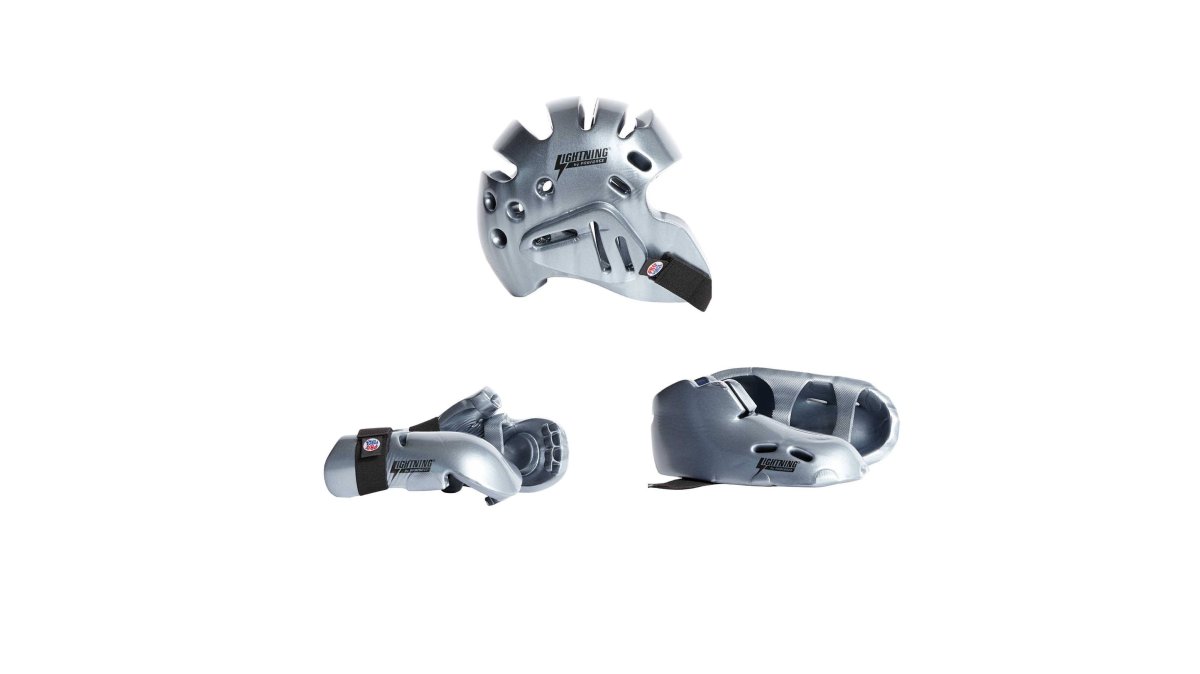
Pros:
- One purchase covers head, hands, feet, and mouth
- Five color options for matching a school uniform
- Foam-dipped construction suited to school sparring
Cons:
- Not built for heavy MMA contact
- Foam-dipped padding compresses faster than injected foam
Care and Hygiene for Sparring Gear
Gear odor comes from bacteria trapped in foam and fabric, and it builds fast when equipment goes straight into a bag after training. Air-drying every piece after each session is the single habit that prevents most of it.
ProForce Lighting 5 Piece Sparring Gear →
- Wipe the inside of gloves and headgear with a mild disinfectant wipe
- Turn shin guards and kicks inside out to dry
- Never leave gear sealed in a gym bag overnight
- Wash hand wraps after every session
- Replace a mouthpiece after illness or visible damage
Safety and Fit: What Parents and Adult Athletes Should Know
Proper fit prevents more injuries than any single piece of gear. Loose headgear rotates on impact and exposes the ear, and an oversized glove slides so the knuckle padding lands off-center.
Required Protective Equipment Beyond Gloves
Gloves get the attention, but sparring safety depends on the full set working together:
- Headgear: Protects the forehead, temples, and ears. Check that it does not rotate when you turn your head and that the chin strap stays snug.
- Shin guards: Cover from below the knee to the top of the foot. Guards that stop at the ankle leave the instep exposed to kicks.
- Groin guard: Non-negotiable for any contact discipline. It should stay in place through kicks and stance changes, not shift on every movement.
- Mouthpiece: Protects teeth, jaw, and reduces force transfer to the head. Boil-and-bite models fit better than stock sizes and should be replaced after illness or visible damage.
- Hand wraps: Add knuckle and wrist support inside the glove. Wraps also absorb sweat, which slows foam breakdown.
Glove Weight and Concussion Risk
Heavier gloves reduce the force your partner feels on the receiving end, but they also add mass to your hands. A 16 oz glove swung at full speed carries more momentum than an 8 oz glove.
- Lighter gloves (7-8 oz): Better for grappling and controlled MMA rounds, but less padding between knuckles and your partner's head.
- Mid-weight gloves (10-12 oz): A reasonable middle ground for mixed striking with light contact.
- Heavier gloves (14-16 oz): Standard for boxing and kickboxing sparring, where the extra padding protects both athletes, but they should be paired with controlled power.
Pre-Session Fit Checklist
Run through this before every sparring session:
- Headgear sits snug with no rotation when you turn your head
- Gloves close fully with the thumb locked against the index finger
- Shin guards cover from below the knee to the top of the foot
- Groin guard stays in place through kicks and stance changes
- Mouthpiece fits the upper teeth without gagging
- Hand wraps are tight at the wrist but not cutting off circulation
When to Replace Gear
Replace gear when padding stays compressed after you press it, when stitching opens, or when the shell cracks. Training intensity should never outrun the condition of your protective equipment.
Conclusion
Finding an MMA Overload alternative for sparring gear comes down to inspecting construction, matching material to how often you train, and replacing gear before padding fails. Most buyers get this wrong by chasing the lowest price and paying for it twice.
Frequently Asked Questions
What are the best online retailers for MMA sparring gear?
Look for retailers that specialize in martial arts equipment and offer clear sizing guidance. BlackBeltShop sells foam-dipped sparring gear sets for karate, taekwondo, and MMA training. Their ProForce Lighting 5-Piece Combo Set includes kicks, gloves, headgear, and a mouthpiece for $99.99. Check return policies and customer feedback before buying, especially if you are new to the sport and unsure about sizing.
How do I choose the right sparring gloves for my training level?
Beginners should prioritize knuckle padding and wrist support over advanced features. Look for gloves with thick EVA foam, a secure hook-and-loop closure, and a closed thumb to reduce eye injuries. If you are training primarily in karate or taekwondo, foam-dipped gloves work well. For MMA or grappling-heavy sessions, consider gloves with more wrist stabilization. Always match glove weight to your body weight and training intensity.
How often should I replace my MMA sparring gear?
Replace sparring gear when padding compresses, straps lose tension, or stitching tears. Foam-dipped gear typically lasts 12-18 months with regular training. Inspect gloves and headgear monthly for cracks or flat spots. If you train four or more times per week, expect to replace gear sooner. Proper storage and cleaning extend lifespan significantly.
Are there affordable alternatives to major MMA gear brands?
Yes. Many martial arts retailers offer quality sparring gear at lower prices than big-box sports brands. BlackBeltShop sells their ProForce Lighting 5-Piece Sparring Gear Combo Set for $99.99, which includes gloves, kicks, headgear, and a mouthpiece. The key is checking material quality, stitching, and sizing options rather than assuming higher price means better protection.
What features should I look for in durable sparring equipment?
Prioritize reinforced stitching at stress points, dense foam padding that rebounds after compression, and adjustable closures that stay tight during movement. For gloves, check knuckle padding thickness and wrist support. For headgear, ensure full coverage without blocking vision. Synthetic leather is easier to clean; genuine leather lasts longer but costs more. Read customer reviews about longevity before buying.