

Table of Contents
- Why Martial Artists Seek a Tiger Claw Alternative
- Quick Comparison: Top Training Weapons for 2026
- Durable Martial Arts Training Weapons That Last
- Foam vs Wooden Training Weapons: Which Is Right for You?
- How to Choose Training Weapons for Kung Fu and Other Disciplines
- Top Tiger Claw Alternative Picks from BlackBeltShop
- Conclusion
- Frequently Asked Questions
Last Updated: September 13, 2026
Why Martial Artists Seek a Tiger Claw Alternative
A Tiger Claw alternative for training weapons exists because most martial artists eventually hit the same wall: the gear they started with stops matching how they actually train. This guide breaks down what to buy instead, why material matters more than brand loyalty, and which tools hold up under daily use.
Kobudo practitioners, karate students, and ninjutsu enthusiasts hit the same problem: the sai that felt fine at 12 feels wrong at 30, and wooden tools that survived a beginner class crack under serious repetition. Meanwhile, the search for a Tiger Claw alternative for training weapons usually turns up forum threads instead of answers.
Quick Comparison: Top Training Weapons for 2026
The best training weapon depends on your discipline, experience level, and whether you drill solo kata or work with a partner.

| Product | Material | Price | Best For |
|---|---|---|---|
| Black Plastic Sai | Durable plastic | $25.99 | Beginners, kata, kids |
| Red Plastic Sai | Durable plastic | $25.99 | Demos, visibility in drills |
| Chrome Octagon Sai | Chrome-plated steel | $69.99 | Advanced kata, demonstrations |
| Round Black Sai | Metal, black finish | $79.99 | Tournament forms, dojo practice |
| NINJA Combo Set | Carbon steel, nylon rope | $79.99 | Ninjutsu climbing forms |
The pattern is straightforward: plastic handles the early years and safe repetitions, steel handles the precision work that comes later.

Durable Martial Arts Training Weapons That Last
Durability comes down to three things: material, joint construction, and how well the tool matches the force you put into it. A common mistake is buying the heaviest, most "serious" weapon as a beginner, steel sai demand control most new students haven't developed, and wrist strain shows up within weeks. Worse is the reverse: advanced students drilling full-speed forms with plastic that flexes and cracks at the prong.
Material Matters: Steel vs. Plastic vs. Wood
Plastic training weapons are lightweight, inexpensive, and forgiving, right for beginners, children, and high-repetition kata where a dropped weapon shouldn't mean injury. The trade-off is realism: plastic sai don't carry the weight or balance of traditional metal.
Steel gives authentic weight distribution and the feedback serious kata requires. Chrome-plated steel, like the octagon-shaft design on our Chrome Octagon Sai, adds grip control through the faceted shaft. The drawback is cost and careful handling in shared spaces.
Wooden weapons, including the traditional jo staff, sit in the middle. Wood absorbs impact and teaches grip pressure, but it dries out, splinters, and needs maintenance plastic and steel don't.
Foam vs Wooden Training Weapons: Which Is Right for You?
Foam training weapons are built for contact and safety; wooden ones for form accuracy and weight realism. The choice depends on whether a partner swings back, and increasingly on whether a modern synthetic option fits your drill better.
When to Choose Foam
Pick foam when training involves impact against another person, when working with children, or when drilling new techniques at speed before you've built control. Foam absorbs kinetic energy, exactly what you want in sparring drills where reaction time matters more than weapon weight.
The trade-off is feedback: foam compresses on contact, hiding sloppy alignment and grip pressure. Practitioners who train only on foam often find their first session with a weighted tool reveals wrist and elbow habits the foam never punished. Use foam to build timing and distance, then rotate in a heavier tool before those habits set.
When to Choose Wood
Choose wood for solo kata, form refinement, or grip and forearm conditioning. A wooden jo or bokken teaches you to feel the balance point, building joint stability and grip strength that transfer to live steel later. Wood rewards slow, correct repetition and punishes sloppy technique, which is the point.
Wood also has a maintenance schedule foam and synthetics don't. It moves with humidity, dries out in heated spaces, and splinters along the grain where impact stress concentrates. Inspect wooden weapons before every session and retire anything showing deep grain separation, hairline cracks near the tip, or a dull thud instead of a sharp tap.
The Third Option: High-Density Synthetic Polymers
Most comparisons stop at foam versus wood, leaving out the category that has quietly become the default for many dojo programs: high-density synthetic polymers and dense rubber compounds engineered to mimic wood's weight and balance without the splinter risk.
These materials fall between foam and wood on the feedback spectrum. A dense polymer training knife or baton carries enough mass to teach grip pressure and swing mechanics, but flexes on impact instead of shattering, critical in partner drills where a wooden tool's failure mode is a sharp edge and a polymer tool's is a bend or scuff.
What to look for when evaluating a synthetic training weapon:
- Density and heft. A polymer tool that feels hollow or rattles when tapped is a costume piece, not a trainer. Pick it up and compare its balance point to the wooden version of the same weapon.
- Surface texture. Smooth polymers get slick once hands sweat. Textured or ribbed grips hold up better through long kata sessions.
- Flex versus rigidity. A little give is good for partner work. Too much give and the tool stops teaching alignment.
- Temperature behavior. Some polymers get brittle in cold training spaces and soft in hot ones. Ask how the material behaves across the temperature range your dojo actually sees.
A Simple Decision Framework
Work through these questions in order:
- Is another person on the other end of this weapon? If yes, foam or a dense polymer. If no, wood or steel.
- Is the goal timing and distance, or form and alignment? Timing and distance favor foam. Form and alignment favor wood or a weighted synthetic.
- Is the trainee under 12 or brand new to weapons? Foam first, then a light polymer, then wood.
- Does the tool need to survive being dropped, thrown in a gear bag, and shared across a class? Polymer wins on durability per dollar; wood wins on feel.
Most practitioners end up owning at least two of the three categories, because each solves a different problem in the training cycle. The mistake is treating the choice as permanent, it's a rotation that changes as your control improves.
How to Choose Training Weapons for Kung Fu and Other Disciplines
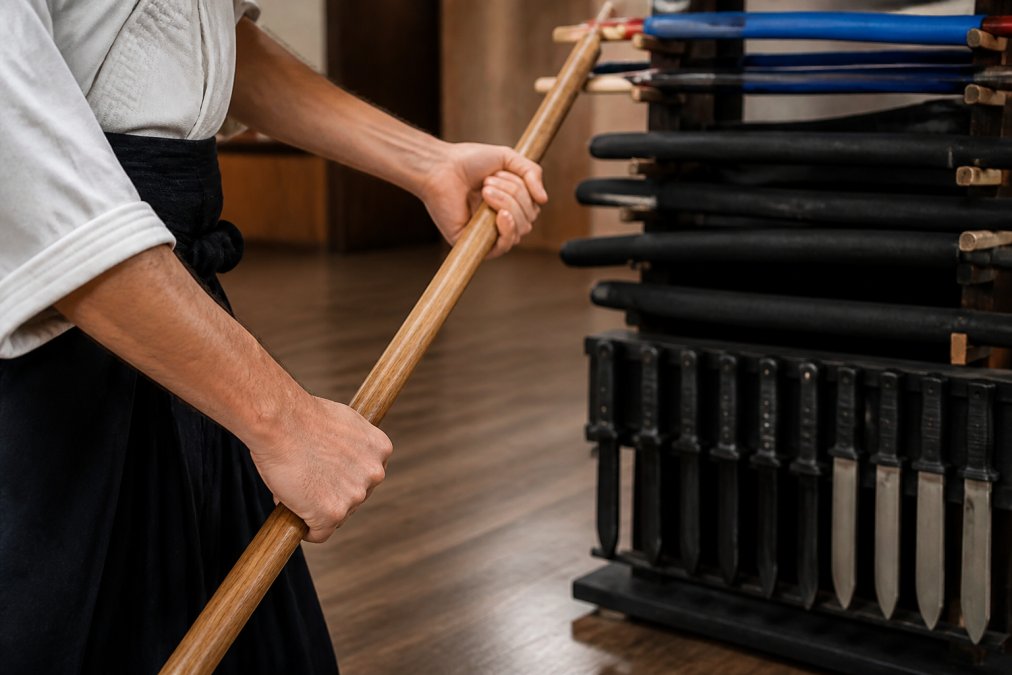
Choosing training weapons for kung fu and other disciplines starts with matching the tool to the tradition. Kung fu forms call for different implements than Okinawan kobudo, and buying a sai for a kung fu curriculum is a mismatch that shows up in competition scoring.
Work through these criteria in order:
- Discipline first. Kobudo and karate training centers on sai, tonfa, and bo. Kung fu uses broadsword, staff, and butterfly swords. Ninjutsu incorporates climbing tools like shuko and ashiko.
- Experience level second. Beginners should start with lightweight, safe alternatives. Advanced students should move to weighted, traditional materials.
- Training context third. Solo kata, partner drills, and demonstrations each demand different safety margins.
- Fit last, but don't skip it. Sai length is measured by holding the handle with the blade running back along the forearm toward the elbow. The blade should extend roughly one inch past the elbow, and the handle runs about 5 inches.
Get the discipline and fit right, and the material choice becomes obvious.
The Gap Most Guides Skip: Ergonomic Claw-Shaped Conditioning Aids
If you're searching for a Tiger Claw alternative, the tool you need may not be a weapon at all, it may be a conditioning aid that mimics the claw shape so you can build the grip, wrist, and finger strength the technique demands before picking up a weaponized version.
Traditional claw training relied on hand conditioning, fingertip push-ups, gripping jars, striking sand, that most modern students don't have the time or joints for. Ergonomic training aids load the fingers and wrist in the same positions the technique uses, but distribute pressure across the palm instead of the fingertips.
What to look for in a claw-shaped conditioning aid:
- Curved, hook-like profile. The tool should encourage the same wrist flexion and finger curl the technique requires, not a flat bar grip.
- Adjustable resistance. Bands or spring-loaded versions let you progress from light tension to heavy without buying a new tool.
- Palm-friendly contact surface. A wide, rounded contact area prevents the bruising that comes from gripping a thin metal bar.
- Symmetry. Buy in pairs so both hands develop evenly, most claw techniques are bilateral, and a dominant-hand-only aid creates imbalances that show up in forms.
Progressive Drills: From Empty Hand to Weaponized Claw
Most guides describe the technique and stop. Here's a progression for building it, for solo practice and partner drills alike.
Stage 1, Empty-hand shape and tension. Hold the claw shape 20-30 seconds at a time, several times per session. Keep the wrist neutral and fingers curved without clenching. The goal is endurance in the shape, not maximum force.
Stage 2, Resistance loading. Add a claw-shaped conditioning aid or a thick rubber band around the fingers. Perform slow open-and-close repetitions, pausing at full closure. Two or three sets of 10-15 reps per hand is plenty; this is a small-muscle group and it fatigues fast.
Stage 3, Grip and wrist integration. Move to a weighted object, a dense polymer training tool, a wooden dowel, or a small sandbag, and practice the claw shape against a moving load, rotating the wrist through its range while maintaining the shape. This is where Stage 2 strength transfers to actual technique.
Stage 4, Partner drills at controlled speed. With a partner, practice trapping, redirecting, and controlling the partner's wrist or forearm using the claw shape. Start at walking pace and only increase speed when the shape holds without conscious effort. Foam or dense polymer training tools are the right choice here, wood and steel have no place in this stage.
Stage 5, Weaponized application. Only after Stages 1-4 feel automatic should you add a weaponized or weapon-adjacent tool. The claw shape should now be a default hand position, not something you think about.
Matching the Aid to the Discipline
The same claw-shaped aid serves different purposes depending on your art. Kung fu practitioners build grip strength that transfers to butterfly swords and tiger fork forms. Kobudo students reinforce the wrist alignment sai and tonfa techniques depend on. Ninjutsu practitioners bridge to shuko-style climbing and gripping work, where finger and wrist strength limits progress long before technique does.
That's the practical answer to the Tiger Claw alternative question: the right tool isn't a single weapon, it's a small kit, a conditioning aid for strength, a dense polymer or foam tool for partner work, and a weighted traditional tool for form. Build the kit in that order and the technique follows.
Top Tiger Claw Alternative Picks from BlackBeltShop
Our top picks for a Tiger Claw alternative for training weapons come down to five tools covering the full range of practice, from first kata to advanced forms. Each solves a specific training problem.
Plastic Sai for Safe Kata Practice
The Black Plastic Sai is the right starting point for anyone new to weapons training. Built from durable plastic with a traditional sai shape, it lets beginners learn correct form without the injury risk of metal. The comfortable grip reduces slips during fast kata, and the balance supports fluid movement through forms.
At $25.99, it's the lowest-risk way to find out whether sai training suits you before committing to steel, and the practical choice for young martial artists and instructors running group classes where equipment gets shared and dropped.
The Red Plastic Sai serves the same role with one addition: the bright red color makes it easy to track during demonstrations and group drills, which matters when teaching a room full of students.
Traditional Metal Sai for Advanced Training
Once your form is stable and grip consistent, steel is the next step. The Chrome Octagon Sai brings chrome-plated steel construction with octagon-shaped shafts that improve grip and control over a smooth round shaft. It's sold as a pair, as symmetrical dual-sai technique requires.
At $69.99, it's a serious tool for practitioners who've outgrown plastic. The Round Black Sai sits at the top of the range at $79.99, with a traditional round design, black finish, and balanced weight for smooth spins, blocks, and strikes. Both suit tournament demonstrations and dojo practice where the weapon must look and feel authentic.
Ninja Combo Set for Specialty Training
For ninjutsu practitioners, the NINJA Combo Set covers ground no sai can. It includes a carbon steel grappling hook with a foldable design and a 33-foot nylon rope, hand climbing claws (Shuko) with adjustable wrist straps, and foot spikes (Ashiko) that strap over training tabi boots.
At $79.99, it's a complete training array rather than a single weapon. Every component is adjustable and assembles or disassembles quickly, which matters for dojo practice and historical demonstrations where setup time is limited.
Conclusion
The real challenge with a Tiger Claw alternative for training weapons isn't finding options, it's matching the tool to your discipline, experience level, and the repetition you actually put in weekly. Buy plastic before steel, wood before foam only if your training is solo, and measure sai before you commit.
BlackBeltShop stocks all five picks in this guide, with free shipping on orders over $129 and a veteran-owned team that trains in the same disciplines you do. Whether you need a first plastic sai or a full ninjutsu combo set, our gear is built for the repetition real training demands. Check out the full training weapons collection and find the tool that matches where you are right now.

Frequently Asked Questions
What are the best materials for martial arts training weapons?
The best material depends on your training goals. Plastic and foam are ideal for beginners and safe kata practice, as they reduce injury risk. Wooden weapons build strength and simulate realistic weight for forms. Steel or metal training weapons, like the Chrome Octagon Sai, offer the most authentic feel for advanced practitioners and demonstrations. Consider durability, safety, and your discipline's requirements when choosing.
How do I choose between foam and wooden training weapons?
Choose foam for sparring and drills where contact is frequent and safety is paramount, especially for children or beginners. Wooden weapons suit solo forms, conditioning, and building grip strength. If your art involves impact with another weapon, foam reduces injury risk. For kata and traditional practice, wood provides the necessary weight and feedback. Many martial artists own both types for different training phases.
Are there reliable alternatives to Tiger Claw for sparring gear?
Yes. BlackBeltShop offers a range of durable training weapons, including plastic and metal sai, that serve as reliable alternatives. Their products are designed for rigorous training and come with a 99.7% positive feedback rating from over 14,000 reviews. You can find safe, affordable options for kata, sparring, and demonstrations without compromising on quality.
What factors determine the durability of training weapons?
Durability depends on material quality, construction, and intended use. Metal sai with chrome plating resist rust and impact, while high-density plastic sai withstand repeated drops. For wooden weapons, kiln-dried hardwoods like oak or hickory resist cracking. Proper maintenance, such as cleaning and storing in a dry place, also extends lifespan. Always inspect weapons for wear before training.
Where can I find affordable martial arts training equipment?
BlackBeltShop sells martial arts supplies at 10-40% below regular retail, with free shipping on orders over $129. They offer a variety of training weapons, including plastic sai for $25.99 and metal sai starting at $69.99. With a 99.7% positive feedback score and thousands of reviews, you can trust the quality and value.